Tag: certificates

Oklahoma and California win Reintegration Champion awards for 2022 laws

On January 10 we posted our annual report on new laws enacted in 2022 to restore rights and opportunities to people with a record of arrest or conviction. Like our earlier reports, it documents the steady progress of what we characterized two years ago as “a full-fledged law reform movement” aimed at restoring rights and dignity to individuals who have successfully navigated the criminal law system. This year’s criminal record reforms bring the total number of separate laws enacted in the past five years to more than 500. Posted below is our fourth annual legislative Report Card recognizing the most productive states in 2022. Reintegration Awards for 2022 While more than a handful of states enacted noteworthy laws in 2022, two states stand out for the quantity and quality of their legislation:  California and Oklahoma share our 2022 Reintegration Champion award for their passage of at least two major pieces of record reform legislation. California – Enacted a whopping 11 new laws, including the broadest general record clearing law in the nation, a direction to courts to effectuate clearing of marijuana records, removal of restitution as a bar to clearing criminal records, easing access to judicial certificates of rehabilitation, and simplification of the process for certifying people with criminal records to work in community care. California’s governor also vetoed a bill that would have facilitated background screening by eliminating court-imposed restrictions on online access to personal identifying information. Oklahoma – Enacted a major automatic record clearing law and the most sweeping update to an occupational licensing scheme of any state in the country this year. Oklahoma also passed a significant law allowing young people who successfully complete the state’s youthful offender program to have their charges dismissed and expunged. Another eight states earned an Honorable Mention for their enactment of at least one significant new record reform law: Colorado – Expanded automatic sealing to include all offenses eligible for petition-based sealing, reduced the waiting period for low-level drug possession from three years to two, and enhanced procedural rights of those applying for occupational licenses. Connecticut – Made it easier for people with felony convictions to work in dozens of occupations under the state department of public health and authorized a binding preliminary determination. Delaware – Enacted the “Fair Chance Licensing Act,” establishing a binding preliminary application process, providing that many records may not be grounds for denial (convictions over 10 years old with no intervening convictions; pardoned, sealed, or expunged convictions; non-conviction records; and juvenile adjudications). Even “substantially related” crimes must be given an opportunity for a waiver via a board vote. Delaware also authorized automatic expungement of records of charges lacking a final disposition and prohibited higher education institutions from inquiring into an applicant’s criminal history. Indiana – Eliminated the one-year waiting period for sealing non-conviction records, including uncharged arrests, and made this relief automatic. Louisiana – Strengthened and extended its occupational licensing law, by establishing a binding preliminary determination, providing for appeal, bringing many new boards under its general licensing limits, and adopting new factors to be considered in determining “direct relationship.” The state also provided unusually broad record relief for victims of human trafficking. Maryland – Legalized the personal use of up to 1.5 ounces of cannabis for adults 21 and older, authorized resentencing and expungement of marijuana conviction records and established a business assistance fund that prioritizes individuals with cannabis convictions. Maryland also enacted a law removing state authority over the delinquency of children aged 13 and under. Missouri – Missouri voters amended the state constitution to legalize personal use of marijuana, and at the same time authorized release from prison for those serving prison sentences for marijuana trafficking, provided for automatic expungement for numerous marijuana convictions upon completion of sentence, and extended preference in commercial licensure to sell legalized marijuana to those with convictions. In addition, Governor Mike Parson has become the most prolific pardoner in the state in more than 40 years, working efficiently to reduce a case backlog built up over many years. Rhode Island – Legalized adult possession of small amounts of marijuana, provided for automatic expungement of convictions for decriminalized marijuana offenses, and waived costs as a bar to expungement for anyone who has been incarcerated for a marijuana offense. Low marks go to two states that enacted no record reform laws at all in 2022. While there are many other states in this category this year, the legislatures of Alaska and Wisconsin earn their place at the bottom of the heap for having been equally unproductive in 2021, 2020 and 2019, years in which almost every other state passed at least some law limiting access to and use of criminal records.  Wisconsin’s one saving grace is the extensive record of pardoning by Governor Tony Evers in the past 30 months, during which he has pardoned more than 600 individuals, 325 in 2022 alone. Looking ahead to 2023, we expect to see a continuing expansion of eligibility for record clearing, and reduction of access barriers like lengthy waiting periods, outstanding court debt and application-related costs.  We also predict efforts to improve records management to accommodate automation of record clearance.  We look for extension of state fair employment laws, and further facilitation of occupational licensing, both areas where bipartisan reforms have benefitted from helpful model laws. We are slightly less optimistic about additional progress toward dismantling the structure of felony disenfranchisement, which has become mired in faction looking toward the presidential race in 2024. Hopefully, 2023 will see some record reform action in Congress and federal agencies, including measures to extend access to government-guaranteed loans and contracting opportunities to small businesses owned or managed by people with a criminal history. We have come a long way just in the past five years, but there is still a long way to go.     Read more

“Certifying Second Chances”

This is the title of a provocative new article by Cara Suvall, Assistant Clinical Professor of Law at Vanderbilt Law School, and Director of the Youth Opportunity Clinic.  The article, forthcoming in the Cardozo Law Review, catalogues and analyzes the costs and burdens that deter people from accessing certificates intended to enhance employment opportunities.  Professor Suvall focuses particular attention on certificate programs in Tennessee, Georgia, and New York, which vary widely in eligibility criteria, administration, and legal effect.  She highlights the learning, compliance, and psychological barriers that limit effectiveness of existing certificate programs, and describes proposals to lower those barriers. Here is the abstract: Policymakers around the country are grappling with how to provide a second chance to people with criminal records. These records create collateral consequences—invisible punishments that inhibit opportunity in all facets of a person’s life. Over the past seven years, states have repeatedly tried to legislate new paths for people trying to move on with their lives. State legislators passed more than 150 laws targeting collateral consequences in 2019 alone. But what happens when these paths to second chances are littered with learning, compliance, and psychological costs? The people who most need these new opportunities may find that they are out of reach. A major problem, I argue, is the administrative burdens involved in accessing these remedies. Because of these hurdles, people with fewer resources—the population that would most benefit from the help—are the ones most likely to find these second chances out of reach. The Article closely examines one increasingly popular type of second-chance program: certificate laws that remove employment barriers. Building on recent research identifying the low usage rates of petition-based second-chance programs, this Article catalogues and analyzes the costs and burdens placed on people attempting to access employment certificates. Of particular concern is not only these low usage rates themselves, but also the identity of those least likely to access these interventions. Second-chance programs like employment certificates that provide a way forward for people with greater resources while leaving behind those without may be more harmful than helpful when placed in the larger context of mass criminalization and social change, even if they help the small number of individuals who do access them. In contrast, a well-designed second-chance initiative that appropriately considers administrative burdens and the way that interventions like employment certificates fit in to the broader picture of social change could provide short-term benefits to people with criminal records while also bolstering larger-scale reforms to the criminal legal system. Read more

Introducing the new Restoration of Rights Project

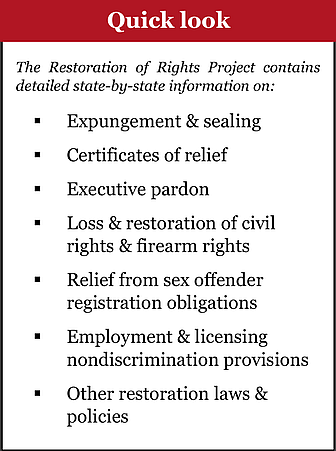
  The Collateral Consequences Resource Center and its partner organizations, the National Association of Criminal Defense Lawyers, the National Legal Aid and Defender Association, and the National HIRE Network, are pleased to announce the launch of the newly expanded and fully updated Restoration of Rights Project. The Restoration of Rights Project is an online resource that offers state-by-state analyses of the law and practice in each U.S. jurisdiction relating to restoration of rights and status following arrest or conviction.   Jurisdictional “profiles” cover areas such as loss and restoration of civil rights and firearms rights, judicial and executive mechanisms for avoiding or mitigating collateral consequences, and provisions addressing non-discrimination in employment and licensing.  Each jurisdiction’s information is separately summarized for quick reference.    In addition to the jurisdictional profiles, a set of 50-state comparison charts summarizes the law and illustrates national patterns in restoration laws and policies.   We expect to supplement these resources in weeks to come with jurisdiction-specific information about organizations that may be able to assist individuals in securing relief, and information on other third-party resources. The resources that comprise the Restoration of Rights Project were originally published in 2006 by CCRC Executive Director Margaret Love, and she has continued to keep them updated.  As a result, the profiles and comparison charts have expanded over the years to broaden their scope and to account for the many changes in this complex area of the law.  Love’s research has recently been hosted by CCRC and NACDL, and it appears as an appendix to the treatise on collateral consequences published jointly by NACDL and Thompson Reuters (West). Project resources have now been re-organized into a unified online platform that makes them easier to access, use, and understand. The short “postcard” summaries of the law in each state — which serve as a gateway to more detailed information — have also been reviewed and revised to provide a more current and accurate snapshot of applicable law in each state. The Project is intended as a resource for practitioners in all phases of the criminal justice system, for courts, for civil practitioners assisting clients whose court-imposed sentence has exposed them to additional civil penalties, for policymakers and advocates interested in reentry and reintegration of convicted persons, and for the millions of Americans with a criminal record who are seeking to put their past behind them. The Restoration of Rights Project is available now at: http://restoration.ccresourcecenter.org Read more

Judge Gleeson issues a “federal certificate of rehabilitation”

In his final week on the bench, in an opinion that may in time prove among his most influential, U.S. District Judge John Gleeson issued a “certificate of rehabilitation” to a woman he had sentenced 13 years before.  See Jane Doe v. United States, No. 15-MC-1174 (E.D.N.Y., March 7, 2016) (Jane Doe II).  The opinion breaks new ground in holding that federal courts have authority to mitigate the adverse effects of a criminal record short of complete expungement.  Along the way, it confirms that a district court may use its inherent equitable powers to expunge convictions in “extreme circumstances,” an issue now on appeal to the Second Circuit in Judge Gleeson’s earlier expungement case.  (Jane Doe I has been calendared for argument on April 7.)  The opinion also finds a role for federal probation to play, including under New York State’s “robust” certificate system, which lifts mandatory state law bars to employment and other opportunities.  It does all of this in a manner that should make it hard for the government to appeal, since “this court-issued relief aligns with efforts the Justice Department, the President, and Congress are already undertaking to help people in Doe’s position shed the burden imposed by a record of conviction and move forward with their lives.”     Joe Palazzolo at the Wall Street Journal blog noted that   More than a dozen states and the District of Columbia issue certificates to certain ex-offenders who have shown their days of crime are behind them, usually by remaining offense-free for a long stretch. . . . .  There is no equivalent federal certificate. So Judge Gleeson invented his own. Judge Gleeson summarized his opinion as follows: I conclude that while Doe has struggled considerably as a result of her conviction, her situation does not amount to the “extreme circumstances” that merit expungement.  That said, I had no intention to sentence her to the unending hardship she has endured in the job market. I have reviewed her case in painstaking detail, and I can certify that Doe has been rehabilitated. Her conviction makes her no different than any other nursing applicant. In the 12 years since she reentered society after serving her prison sentence, she has not been convicted of any other wrongdoing. She has worked diligently to obtain stable employment, albeit with only intermittent success. Accordingly, I am issuing Doe a federal certificate of rehabilitation.   Judge Gleeson sees a constitutional dimension to the collateral consequences of conviction, and a corresponding obligation of sentencing courts to relieve them: There is no longer a need to deprive Doe of her liberty interests in the way collateral consequences imposed by the law have been doing. As her sentencing judge, I owe it not only to Doe, but to her family and community, to do my part to lift any remaining hardship on her. His opinion compares the “forgetting” model, exemplified by expungement, with the “forgiveness” model, which “acknowledges the conviction but uses a certificate of rehabilitation or a pardon to symbolize society’s forgiveness of the underlying offense conduct.”  It points out that “it is not clear to me that expungement would significantly help Doe, as her conviction will still appear on her nursing license and in private criminal record databases.” The forgiveness model, which preserves the public record of a conviction, is gaining favor in the reentry community for both functional and philosophical reasons. . . . Where expungement relief is unavailable or otherwise unhelpful, I believe a certificate of rehabilitation can significantly alleviate the collateral effects of a criminal record by emitting a powerful signal that the same system that found a person deserving of punishment has now found that individual fit to fully rejoin the community. Judge Gleeson reviews the certificate schemes enacted by many states, including the one adopted in Illinois through the efforts of then-State Senator Obama, and concludes that “t]he federal system has much to gain from adopting a certification system similar to those in certain states.”  If authorized by law, a federal certificate would not only evidence rehabilitation, it could also lift mandatory collateral sanctions. The opinion describes the key role a sentencing court can play in encouraging prospective employers and others to give a person with a criminal record a second chance: Most prospective employers do not have the time or resources to gain a comprehensive understanding of who Doe is, and then to figure out what weight, if any, her conviction should play in the hiring process. So I have done that for them. I have reviewed each page of Doe’s trial transcript, presentence report, probation reports, deposition transcript, and other documents she and the government provided to me for a holistic view of her character and competency today. I find that there is no relationship between Doe’s conviction and her fitness to be a nurse. See N.Y. Correct. Law § 752 (prohibiting the denial of employment unless there is a “direct relationship” to the offense of conviction or “the employment would involve an unreasonable risk to property or to the safety or welfare of specific individuals or the general public”); N.Y. Exec. Law § 296(15) (making unlawful the denial of employment due to a finding of moral character based on a criminal conviction). Any legitimate impact that her fraudulent actions more than 15 years ago may have had on her suitability for employment no longer exists. Jane Doe is rehabilitated. Appended to the opinion is an actual certificate, presumably designed in Judge Gleeson’s chambers, which embodies the court’s recommendation “that she be welcomed to participate in society in the ways the rest of us do.”  Moreover, “[i]f her attorney decides to make an application for a pardon from the President, I believe the certificate will help her make a strong case.”  If other federal courts accept Judge Gleeson’s invitation to engage in post-sentence record-mitigation efforts, it could be as significant for collateral consequences in federal cases as Booker was for federal sentencing.  Read more

Forgiving v. forgetting: A new redemption tool

The following thought-provoking piece about the growing popularity of judicial “certificates of good conduct” was first published in The Marshall Project (www.themarshallproject.org) a nonprofit news organization focused on the US criminal justice system. The “forgiving” approach to avoiding or mitigating collateral consequences is an important alternative to the “forgetting” approach advocated by proponents of expungement or sealing, which tend in any event to be limited to minor dated offenses or arrests not resulting in conviction.         Forgiving v. Forgetting:  For offenders seeking a new life, a new redemption tool. In February of 2003, a much younger Barack Obama rose before the Illinois State Senate to introduce a new piece of legislation that, he said, contained a compromise. The bill would help job-seekers who had long ago been convicted of a nonviolent crime (or two, at most) overcome the barriers to employment that came with having a criminal history. But the bill would do so without expunging their records. Instead, Obama’s bill would create a final, years-later stage on the timeline of these ex-offenders’ cases. They had already completed the stages of arrest, booking, indictment, plea bargaining or trial, sentencing, incarceration and/or probation. Now, ex-felons who had stayed crime-free for a few years would be eligible to come back to court and, in a full-blown hearing before a judge, attempt to “prove” that they had been rehabilitated. Any ex-offender who succeeded in doing so, Obama announced, would be granted one of two new legal documents, the Certificate of Good Conduct or the Certificate of Relief from Disabilities. The certificate would represent an official assurance to employers – though, again, short of full expungement – that the ex-offender should no longer be judged for his or her crimes. More concretely, the good conduct certificate would make the ex-offender eligible for a range of municipal jobs, including in the public schools, the transit system, and the parks; the certificate of relief would remove barriers to a range of licenses, from real estate to barbering, cosmetology, and mortician’s licenses. Finally, any private employer who hired the now officially rehabilitated ex-offender would be insulated from liability suits claiming negligent hiring. Obama’s bill was passed and went into effect one year later. Ever since, the granting of so-called Certificates of Rehabilitation has become an increasingly popular compromise version of full expungement in courts around the country. Between 2009 and 2014, nine states and Washington, D.C. began issuing the documents, also called certificates of relief, recovery, achievement, or employability. “These certificates are a remarkably dynamic new option,” says Kari Hamel, a civil legal aid attorney in North Carolina who is working to make the certificates – available in that state since 2011 – more accessible to more people with criminal records. “It’s a way of showing employers that the crime someone committed probably wasn’t committed yesterday. It makes what has happened since the crime a fully official part of that person’s record, for all employers to see.” “That’s the key,” she adds. “Rehabilitation is absolutely a part of a person’s history of trouble with the law, it’s just the second part, the positive part.” Paul Biebel, the presiding judge for Chicago’s criminal court, agrees that the certificates are a promising new option. “Only over the last few years have we seen more of these coming through the court,” he says of the certificates, “but I feel very strongly that they are an additional tool in a judge’s toolbox to evaluate people. We judges are prepared to send people to prison. But now, if the evidence proves rehabilitation, we also have a tool for redeeming people.” The new certificates have burst onto the scene amid emerging bipartisan consensus that the consequences for committing low-level nonviolent crimes – including the collateral consequences, such as difficulty getting a job[1] years later – should not be interminable. The Redeem Act, a bill sponsored by Senators Cory Booker and Rand Paul that would expand expungement for crimes committed as a juvenile, has picked up steam in Congress. President Obama, meanwhile, has highlighted the issue of the long-term impact of criminal records, particularly through his My Brother’s Keeper[2] initiative. This consensus is rooted in the fact that between 70 and 100 million Americans have an arrest, charge or conviction in their pasts. And, with the rise of the Internet, even a minor run-in with the law has been transformed from a temporary experience into a permanent one. This does not mesh well with the American ideal of self-reinvention. Yet despite the emerging agreement that many ex-offenders deserve second chances, not everyone agrees that these new certificates are the best way to go about providing redemption. Sharon Dietrich is one such critic. Dietrich is a civil legal aid attorney in Philadelphia and the author of “One Strike and You’re Out,” a report on the collateral consequences of criminal records, and she believes full expungement is always preferable to certificates. “Forgetting,” she says, “either by expunging someone’s record altogether or by permanently sealing it, is a much better solution than forgiving, which is what these certificates claim to do.” The certificates are a “weak compromise,” she adds, because they “rely on employers to do the right thing. But most employers will ignore the document that says you’ve been rehabilitated, and focus instead on the part about how you were arrested.” Supporters of the certificates argue that “forgetting” is a pipe dream. For one thing, law enforcement agencies often resist expungement, because it purges the record of information that might be useful in future investigations. James Jacobs, a professor of law at New York University and the author of “The Eternal Criminal Record,” says that even if expungement were more available, it would be a kind of “fraud” in the age of the Internet. “Expungement is not amnesia,” he says. “The information remains out there on the Internet. These private background check companies [such as LexisNexis, HireRight, and FirstAdvantage] have no incentive to remove expunged or out-of-date information.” Background checks on job applicants are frequently inaccurate[3] even without expungement, he said. Then again, certificates are not useful at all if ex-offenders – and employers – do not know about them, or do not know who is eligible. And even once ex-offenders know about the option, the process of affirmatively filing for a certificate is extremely complex. The burden to prove rehabilitation is on the applicant, not the prosecution. To be successful requires gathering documents from multiple agencies, letters of support from community members, and proof of sobriety, then arranging all of it into a narrative that demonstrates “rehabilitation.” In other words, the success of these certificates depends heavily on local lawyers, primarily from civil legal aid[4] organizations, taking a grassroots approach to informing people about what certificates are available and how to file for them. In New York, for instance, one of the few states to begin offering the certificates before Illinois, an average of only 261 per year were issued between 1995 and 2005. Between 2007 and 2010, as civil legal aid organizations started educating ex-offenders about the certificates, that number shot up to 2,040 per year. More recently, two of the most robust approaches to making these new certificates more accessible and understandable are underway in Illinois and North Carolina. In Chicago, Cabrini-Green Legal Aid has led the effort to inform people about the certificates. CGLA operates a Help Desk at the downtown Chicago courthouse, as well as a dial-in hotline, to educate ex-offenders about the certificates and get them started with the application process. And, according to Cynthia Cornelius, CGLA’s director of client and community services, the organization has recently begun to meet with and educate local employers. “None of this works unless employers know what these certificates are,” she says, “and why they should respect job applicants who have earned the certificates.” But making the certificates a useful option is not only about education, it is also about representation. So, in a statewide effort called Second Chances,[5] sixteen of the Illinois’ largest law firms have partnered with CGLA, supplying hundreds of pro bono lawyers to help process petitions for certificates. Down in North Carolina, the first step was to make the certificates available under the law, as Obama did in Illinois. Despite the anti-progressive climate in the state legislature, says Bill Rowe, chief counsel of the North Carolina Justice Center, securing “certificate legislation” was politically feasible. “Democrat or Republican, we all know someone here in North Carolina with a minor mistake holding them back,” says Rowe, “and minor mistakes are the types of mistakes we’re talking about forgiving with these certificates, not major mistakes. It’s not a ‘them’ issue, like some of the other divisive issues in the legislature; it’s an ‘us’ issue.” With the certificates in place, the next step was getting the word out. Hamel, the civil legal aid attorney, explains that Legal Aid of North Carolina operates mobile legal clinics deep in the Blue Ridge mountains, informing the people there about the certificates. Before each clinic, Hamel notifies the local newspapers in the towns where she is headed, asks the radio stations to broadcast PSAs, and contacts local domestic violence shelters and V.A. centers to get people to come out for the clinic. To bring employers on board, Hamel has help from Ben David, a local D.A. in Wilmington, North Carolina, who has convened the Hometown Hires program. David meets regularly with hundreds of the top employers in southeastern North Carolina to convince them to hire people with criminal records, especially people who have these certificates. “This is about working on criminal records,” David says, “which takes a lot of time, because it’s about the long-term, not just the open-and-shut part of the case. But as a D.A., I feel I should take active steps to stop prosecuting folks who are just trying to get jobs, and these certificates and the other new options, I think, are a way of stopping the endless prosecution of job seekers.” But in the end, says Jacobs, even with robust information campaigns, certificates are “not a magic bullet.” “If everyone gets a certificate,” he says, “then the certificate has no credibility, and employers won’t respect it. So we can’t give certificates to people who don’t deserve one.” But the hard truth, Jacobs says, is that a considerable fraction of people with criminal histories do not deserve a certificate, because they “are still struggling with drug addiction, mental illness, and tremendous deficits. They are not rehabilitated to the point of deserving a certificate, but they do deserve our help.” In other words, rehabilitation for most ex-offenders requires actually working with them while they are being rehabilitated, not just rewarding them afterward if they can do it on their own. “Finding a route back to where some of these people have never been,” says Jacobs: “That requires more than just a certificate.”     [1] Over 80 percent of employers run criminal background checks, according to the Society for Human Resource Management. [2]  My Brother’s Keeper initiative is a collaboration between the White House and local businesses, foundations, and cities, aimed at creating more jobs and civic opportunities for young men of color [3] In 2012, 600,000 job applicants received inaccurate FBI background checks. For these reasons, Jacobs argues, ex-offenders are better off if they are equipped with an affirmative document, like a certificate, with which they can respond when employers inevitably find something damning on the Internet. [4] The right to counsel is not guaranteed when there is no active criminal prosecution, which is why civil legal aid lawyers, not criminal defenders, are responsible for helping people with these certificates. [5] The Second Chances program is part of the nationwide IMPACT Project, a project inspired by Vice President Joe Biden to encourage pro bono lawyers to work more closely with legal aid lawyers.     Read more