Tag: Certificate of Rehabilitation

Gleeson Certificate enters “uncharted waters”

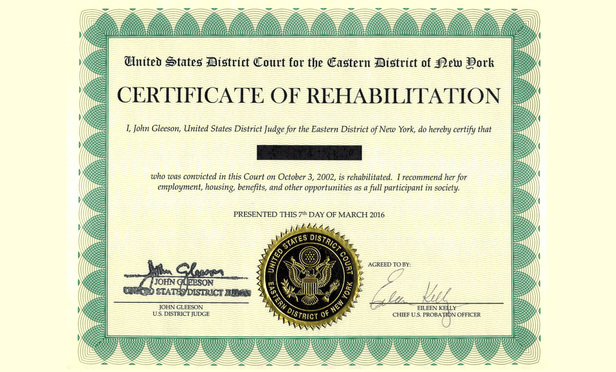
The New York Law Journal published an article over the weekend about the “novel relief” provided by the federal certificate of rehabilitation issued by former Judge John Gleeson on March 7, just days before he stepped down from the bench.  A reproduction of the certificate reveals its official appearance, complete with court seal and signatures of Judge Gleeson and the Chief U.S. Probation Officer. The government has until April 7 to appeal – the very day its appeal of Judge Gleeson’s expungement order in his first Jane Doe case will be argued in the Second Circuit.  The jurisdictional issues presented by the certificate order may be similar, if only because the certificate has some effect under state law.  See N.Y. Correct. Law §§ 703(7), 752, both cited in Judge Gleeson’s opinion.  It is likely that others similarly situated will apply for similar relief. The text of the NYLJ article follows: Expungement is Denied, But Court Offers Novel Relief Andrew Keshner, New York Law Journal 2016 While a federal judge declined to expunge a woman’s fraud conviction, he devised his own certificate meant to prove her rehabilitation to employers, landlords and others. Eastern District Judge John Gleeson said he could not provide Jane Doe with her sought-after remedy of expunging her 2002 conviction, but gave her a “lesser form of relief” through his issuance of a certificate of rehabilitation where he said he recommended Doe “for employment, housing, benefits and other opportunities as a full participant in society.” Though certificates of rehabilitation exist in New York and several other states and are generally meant to relieve certain licensing, employment and benefit barriers that attach to convictions, there is no statutory counterpart in the federal system. In Doe v. United States of America, 15-mc-1174, Gleeson said the certificate, also signed by the Eastern District’s chief probation officer, memorialized his conclusions for Doe’s future employers. “I hope they will give my careful consideration of Doe’s current suitability for employment significant weight, and conclude that it far outweighs the effect of her aberrant criminal conduct all those years ago,” Gleeson wrote in his March 7 decision, just days before he stepped down from the bench to join Debevoise & Plimpton. And if Doe’s attorneys chose to seek a presidential pardon, “I believe the certificate will help her make a strong case.” “The federal system has much to gain from adopting a certification system similar to those states,” Gleeson wrote. The 32-page ruling is not Gleeson’s first analysis of the jurisprudence surrounding expungement. Though the petitioner in the current matter was able to find intermittent nursing work and start her own cleaning business, Gleeson last year granted expungement to another woman whose job prospects were crippled following her conviction for a minor role in a fraud scheme. Gleeson said at the time that he “sentenced her to five years of probation supervision, not to a lifetime of unemployment” (NYLJ, June 3, 2015). Prosecutors in the Eastern District U.S. Attorney’s Office are appealing the decision. The U.S. Court of Appeals for the Second Circuit is scheduled to hear arguments on April 7. Other judges have wrestled with expungement requests. For example, Gleeson’s Eastern District colleague, Judge Raymond Dearie, said he regretted he could not erase the conviction of a woman who “turned her life around” and urged prosecutors, judges and Congress to re-think expungement laws (NYLJ, Oct. 15, 2015). In the current case before Gleeson, Doe was passenger in a staged car accident scheme. In 2002, a jury found her guilty of conspiring to commit and committing health care and mail fraud. Doe’s adjusted income was less than $15,000 in the two years before the offense, according to her pre-sentence report. She was also raising two children by herself with $80 a week in child support from the father. Gleeson ultimately imposed an 11-month sentence and almost $7,500 in restitution. When Doe was released from prison in 2004, she went through periods of employment and unemployment in the nursing field. Due to the conviction, her state nursing license was suspended in 2006 for two years, with the second year stayed, as well as two years of probation. When the suspension ended, Doe went back to work. Gleeson noted that Doe applied unsuccessfully to a number of nursing agencies, some of which mentioned the conviction, but others did not. In 2014, Doe started her own house-cleaning business and managed to make some money while she applied to other nursing agencies. Doe first moved to expunge the conviction in 2008 and Gleeson denied the bid. In 2013, he denied her effort to vacate the conviction. Doe filed the instant bid last year, invoking Gleeson’s prior expungement decision, which he had released approximately a month earlier. “The government might have responded by engaging in an effort to help Doe seek employment,” said Gleeson, noting how other U.S. Attorney’s offices across the country were taking steps like hosting employment fairs and holding community re-entry forums. But the prosecution instead opted to oppose, Gleeson said. He invited attorney Margaret Colgate Love, co-author of “Collateral Consequences of a Criminal Conviction: Law, Policy and Practice” to submit an amicus brief addressing issues including whether he was authorized to enter a certificate of rehabilitation. In the filing, Love, represented by Jones Day, said while there was no federal law permitting the issuance of a federal certificate of rehabilitation, there were “two mechanisms, each perhaps underappreciated but with deep historical roots, by which the court may recognize an individual’s rehabilitation.” One was a so-called writ of audita querela, enabling the reopening of a judgment in “extraordinary circumstances” through the All Writs Act of 1789. The other was the recommendation of a clemency grant to the president. In his ruling, Gleeson said there was “no reason to issue such a writ here because Doe has not requested that I vacate her judgment entirely, but rather that I delete the record of it.” He also waved off the prosecution’s argument that he lacked the jurisdiction to hear the motion. He noted the Second Circuit’s expungement standard said it should be used only for “the unusual or extreme case” —a standard that “unfortunately” was not met here. He said there were reasons apart from the conviction that Doe lost jobs or had been declined offers “including patient complaints and the usual ebb and flow of clientele.” Though acknowledging she “struggled considerably,” Gleeson said he was not clear how expungement would significantly help her. Her conviction would st Read more

DOJ argues federal court has no power to expunge

What relief is available for people with a federal conviction who cannot find or keep a job? Part of the answer may soon be found in two cases from Brooklyn that raise the question whether a federal judge has the power to expunge a conviction whose validity is conceded. In the first case, U.S. v. Jane Doe (Jane Doe I), the Justice Department has appealed Judge John Gleeson’s May 21 expungement order to the Second Circuit Court of Appeals. In the second case, also styled U.S. v. Jane Doe (Jane Doe II), Judge Gleeson asked the Department to brief the issue of his authority to expunge.  He also asked the government to advise whether he has authority to “enter a certificate of rehabilitation in lieu of expungement.”  The government has now delivered its answer, and it is “No” to both questions. The government’s brief is fairly predictable.  On the expungement issue, it argues that federal courts have no “ancillary jurisdiction” to expunge the record of a lawful conviction, relying on the Supreme Court decision in Kokkonen v. Guardian Life Ins. Co., 511 U.S. 375 (1994).  As to the court’s authority to issue a certificate of rehabilitation, the government appears to assume that Judge Gleeson was referring to one of the certificates provided for under New York law, and relies on cases holding that a federal court cannot grant relief under a state law.  One clue that this was not what Judge Gleeson had in mind might have been that neither of the New York certificates is called that (though they are considered evidence of rehabilitation), and that the only mention of a certificate of rehabilitation in federal law (Rule of Evidence 609(e)) is generic. Another clue is that no federal court that we know of has ever attempted to grant state relief to a federal offender (with the exception of a few assimilative crimes cases), indicating that the law on this issue is too clear to tempt even even the most creative jurist. The petitioner’s brief is now due on October 5.  The expert’s brief is likely to be due a day or two afterwards. No date has yet been set for oral argument.   Read more

Federal expungement case gets curiouser and curiouser

Visitors to this site are familiar with the expungement order issued by Federal District Judge John Gleeson on May 21.  See Jane Doe v. United States, now on appeal to the Second Circuit.  A second Jane Doe, a codefendant of the first, applied for expungement on June 23, and on June 29 Judge Gleeson ordered the government to show cause on or before August 28 why her application should not be granted.  A hearing has been scheduled for September 18. Yesterday the Judge issued a new order directing the government to include in its briefing “its view as to whether I have authority to enter a certificate of rehabilitation in lieu of expungement, and if so, the appropriateness of entering such a certificate in this case.” It is not clear exactly what Judge Gleeson might have in mind by a “certificate of rehabilitation,” since there is no specific authority in federal law for a court to grant relief so styled, whatever its legal effect, just as there is no specific authority for a federal court to expunge a conviction. Responding to the first Jane Doe’s petition for relief, Judge Gleeson relied upon the court’s inherent authority to expunge her thirteen-year-old conviction “because of the undue hardship it has created for her in getting – and especially keeping – jobs.”  He remarked that “I sentenced her to five years of probation supervision, not to a lifetime of unemployment.” It is possible that Judge Gleeson has in mind the authority New York State courts have, in cases where a first felony offender is sentenced to probation, to issue a “Certificate of Relief from Disabilities” (CRD), which lifts legal barriers in New York law and has a limited effect under the nondiscrimination provisions of Article 23A of New York’s Corrections Law. But since the second Jane Doe was sentenced to a 15-month prison term, she would not have been eligible for this relief even if sentenced by a New York court, but would have had to apply to the Parole Board for a Certificate of Good Conduct (which has much the same legal effect as a CRD). As it is, both Jane Does are eligible, like other federal offenders residing or doing business in New York, for a state law certificate from New York’s parole board.  However, we are unaware that a CRD or any other type of state relief has ever been granted by a federal court in New York.  Indeed, we are unaware of any case in any State where a federal court has ordered relief from collateral consequences under a provision of state law. (If anyone knows of such a case, we welcome enlightenment.) It is true that federal sentencing judges are routinely asked by the U.S. Pardon Attorney for their recommendations in pardon cases that appear meritorious.  However, it is not clear whether either of Judge Gleeson’s Jane Does has applied for a presidential pardon.  If they were to do so, the likelihood of their pardon applications being considered any time soon, at least in the ordinary course, is quite small. We look forward to seeing the government’s brief when it is filed. Read more

Jerry Brown takes back a pardon . . . really?

Jerry Brown reportedly regretted one of his 105 Christmas Eve pardons, after learning from an LA Times article that the recipient had recently been disciplined by federal financial regulators.  He therefore announced that he was rescinding his grant, claiming that the pardon was not yet final because the Secretary of State had not signed the document evidencing it. This is not the first time that a governor or president has had second thoughts about a pardon, but it is unusual for a chief executive to attempt to undo one that has been made public.  Governor Brown’s attempt to retract the pardon may or may not be effective, but it certainly reflects unfortunate disarray in the administration of the pardon power in California for which other deserving pardon candidates may end up paying. Glen Williams Carnes was pardoned on December 24 for a 1989 drug-related offense committed while he was a teenager, for which he spent three years on probation.  In the pardon document, Brown stated the Carnes had received an order from the Orange County Superior Court “evidencing … he has lived an honest and upright life, exhibited good moral character and conducted himself as a law-abiding citizen.” This judicial order, styled a “Certificate of Rehabilitation,” is the first step in the California pardon process, after which applications are submitted by the governor’s office for a second vetting by the Board of Parole Hearings. Later that same day, the Times reported that [F]ederal records show Carnes was disciplined by investment regulators in May 2013. He signed a consent settlement with the Financial Industry Regulatory Authority that states he agreed to be barred from financial investment. The document alleged that he hid an outside business deal and provided investigators with “false and misleading statements that minimized and mischaracterized his involvement.” Carnes did not admit guilt. Securities and Exchange Commission records show the business deal that led to the sanction became what is now Carnes’ company: Global Vision Holdings, a publicly traded corporate umbrella of which Carnes is listed as CEO, chairman of the board and chief financial officer. Currently, Global Vision owns The Place Media, which publishes local magazines placed in hotels, Mamma’s Best, a line of organic food products, and a financial consulting firm. However, SEC records show Global Vision’s last financial report was made in late 2013. In April, it informed the SEC it could not complete its year-end 2013 filing in time “due to recent turnover in its accounting department.” Upon learning from the newspapers of the FINRA sanctions, Governor Brown moved that same afternoon to withdraw the pardon, stating that he had relied to his detriment on the court’s order of rehabilitation, and that in any case the pardon had not yet become final: “This information was not disclosed by the applicant,” Brown’s spokesman, Evan Westrup, said in a written response to The Times. “Without the certificate of rehabilitation, this individual would not have been considered for a pardon. This particular pardon has not yet been attested by the Secretary of State and it has subsequently been withdrawn.” For his part, the disappointed Mr. Carnes told the Times that he planned to contact Brown’s office “first thing on Friday morning as tomorrow is Christmas, to refute your allegations.” The Associated Press reported that Carnes said he was unaware he needed to report the regulatory settlement on his clemency application. Stay tuned for further details in this most recent pardon soap.  In the meantime, we have a couple of comments on the episode.  First of all, it is not at all clear that the Governor’s effort to retract a pardon he had already announced, on grounds that a ministerial formality had not yet been performed, will be held effective if challenged.  The Supreme Court of Michigan recently invalidated a similar attempted retraction by Governor Granholm, there of a commutation she later regretted after protests by his victim’s family.  See Makowski v. Governor, 495 Mich. 465; 852 N.W.2d 61 (June 3, 2014).  See also Marbury v. Madison, 5 U.S. 137 (1803).  We don’t know if Mr. Carnes plans to take his case to court — though the possibility of further embarrassment may discourage him.  (This is apparently why Isaac Toussie didn’t contest President George W. Bush’s retraction of his pardon under similar circumstances — a pardon that was also granted apparently without adequate staffing.) The Carnes episode also reflects poorly on the present state of the California pardon process, and on its reliability in service to the Governor.   Carnes reportedly told the Times that “he went through an extensive background check that took over a year making him eligible for his gubernatorial pardon.”   However, that background check (presumably by the BPH and the governor’s staff) evidently didn’t dig very deep to reassure the Governor that Carnes was a suitable recipient of his public mercy:  A simple Google search by CCRC staff finds Carnes listed on the website of the CFA Institute as an individual “currently serving public disciplinary sanctions for violations of the CFA Institute Code of Ethics and Standards of Professional Conduct or who have resigned their memberships while under investigation for industry-related misconduct.” Nor was the court’s certification of Carnes’ rehabilitation a very effective filter in this case. Carnes was reportedly granted his COR in August 2013, several months after the FINRA sanctions were imposed.  It is unclear whether the court knew of the sanctions when it granted the COR, though they would certainly seem to have reflected poorly on Mr. Carnes’ rehabilitation in that context as well. Finally, while the retraction is unfortunate for Mr. Carnes, it is even more unfortunate for others who are seeking a pardon from Governor Brown, since it is inevitable that an episode like this may dampen his general enthusiasm for pardoning.  This is why it is so very important that those staffing pardons for an elected official do a thorough investigation and be very sure there is nothing about a case that might cause embarrassment.  Neither the BPH nor the court appears not to have done a very thorough job in this case, if our own crude Google-limited investigative efforts are any guide.  And now others awaiting the Governor’s favor may suffer for this poor staffing. We will have more to say in this space about the administration of the pardon power in California.  We believe that its basic framework, notably its reliance on a prior judicial finding of rehabilitation, could be adapted into a comprehensive functional relief system second to none in the country. Read more