Tag: Center for Community Alternatives

Common Application bans the box!

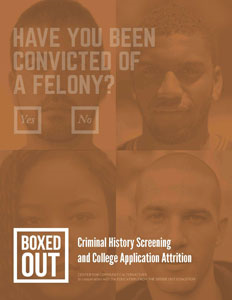
On August 7, 2018, the Common Application announced  that it is dropping the criminal history question from its college application form starting with 2019-2020 applicants.  Currently over 800 colleges and universities use the common application.  The criminal history question first appeared on the common application in 2006.  Individual colleges who are members of the Common Application will still be able to make inquiry on their own. For the past decade, the Common Application has been under pressure from advocates, educators and the U.S. Education Department under the Obama administration to remove the criminal history question from its application form.  The call to remove the criminal history question from college applications first came from the Center for Community Alternatives (CCA) in its 2010 publication, The Use of Criminal History Records in College Admissions Reconsidered.  A second study with policy recommendation was published by CCA in collaboration with the Education from the Inside Out Coalition in 2015, Boxed Out: Criminal History Screening and College Application Attrition, and underscored the harm done by the use of the criminal history box on college applications. As more colleges and universities have banned the box, the Common Application has been under growing pressure to abolish this discriminatory and counterproductive practice.  Removing barriers to the admission of students with criminal history records to higher education is one way to improve public safety, combat mass incarceration, and make reentry meaningful. Read more
New York Bar adopts reentry recommendations

In 2012 newly elected President of the New York State Bar Association (NYSBA), Seymour James, Jr., drew upon his 38 years of experience at the Legal Aid Society of New York City to establish a Special Committee on Reentry and appointed committee members who would spend the next three years researching and studying issues relating to reentry and reintegration. The goal of this Special Committee was to develop a report and recommendations including a consideration of collateral consequences that can have an impact on reentry regarding education, housing employment, medical health, mental health and juveniles. The report identifies some of the best practices to ensure productive lives and minimize recidivism of formerly incarcerated adults and detained juveniles, and of adults and juveniles who can avoid convictions and delinquency findings through innovative diversion programs. On January 29, 2016 the NYSBA House of Delegates adopted the report and recommendations of the Special Committee. One of the key areas the Special Committee studied was education. A significant recommendations was to ban the box on college applications, an issue that was raised by the Center for Community Alternatives (CCA) in its 2015 Report, Boxed Out: Criminal History Screening and College Application Attrition.  This CCA report was discussed earlier on this site.  The NYSBA recommendation supports adoption of the Fair Access to Education Act, a bill pending in the New York Legislature that would amend the Correction Law and Executive Law to make it an unlawful discriminatory practice for any college to ask about or consider an applicant’s past arrests or convictions during the application and admission decision-making process. A second legislative recommendation called upon the Legislature to overturn the 1995 ban on incarcerated persons receiving student financial aid awards to help pay for college courses while in prison. The Special Committee noted that the Tuition Assistance Program (TAP) should be considered a collective investment by society – “an investment we cannot afford to pass up.” Another significant reform adopted by NYSBA was in the area of employment. The Special Committee recommended that New York State adopt a statewide “ban the box” policy by removing the criminal history question from both private and public employers’ applications and delay the background check to a later part of the hiring process. The committee reasoned that this would provide for consistency and uniformity of the law within the state (rather than a city by city approach), as well as give a fair opportunity to job seekers with a criminal history record. Other recommendations contained in the report include: ● Based on the theory that reentry starts at arrest, the report calls for an expansion of diversion programs that will help individuals avoid the stigma of a criminal conviction and at the same time provide supportive programming to assist with employment, education and housing. ● Discharge planning should begin at the time of arrest, and should be accelerated no less than 180 days before anticipated release. ● The Uniform Collateral Consequences of Conviction Act (UCCCA) drafted by the National Conference of Commissioners of Uniform State Laws should be enacted and implemented. More specifically the report calls for the adoption of the UCCCA’s notice and relief provisions to provide a more individualized assessment of the application of collateral consequences to a specific re-entrant. In addition, New York should require thorough analysis of current collateral consequences, especially employment barriers, that hamper an individual’s re-entry so that New York State may develop some sort of relation between the convicted crime and the rights denied. ● The use of work release programs should be expanded and reinvigorated. Work release is a very effective reentry employment program, yet the use of work release has been greatly reduced over the last two decades. The existing work release program needs to be strengthened and made accessible to more individuals who are incarcerated. ● Child support reforms should be enacted to prevent reentering individuals from facing crushing child support arrears that have accumulated while they were in prison. Among the several recommendations in this area is the call for automatic review of child support orders once an individual is incarcerated. ● There should be coordination of medical and mental health care services between corrections and community to ensure continuity of care both while in custody and after release. ● Access to housing for people with criminal history records must be improved by policy changes affecting both public housing and private landlords, by eliminating or reducing the use of criminal history screening. This report is a wonderful resource. Thank you to Seymour James Jr. for having the foresight to establish this Special Committee and congratulations to the committee members for their hard work over the past three years. Read more

New York Times weighs in on college applications and criminal records

The New York Times has published an editorial about the recently issued report of the Center for Community Alternatives on the deterrent effect of questions about criminal records on applications for admission to the State University of New York.  (See the piece about the report “Boxed Out: Criminal History Screening and College Attrition” by CCA Director Alan Rosenthal published in this space 10 days ago.)  The editorial notes that the 24 campuses of the CUNY system do not include “the box” asking about criminal record on their application forms and have reported no safety issues as a result.  Perhaps this will be one of those rare cases where effective public advocacy highlighted in editorial pages will actually have a concrete result. Americans who have criminal histories are often stymied when they encounter college entry applications that ask if they have ever been convicted of crimes. The process, which often brings greater scrutiny to people who answer “yes,” is driving away large numbers of people who present no danger to campus safety and are capable of succeeding academically. Similar problems have faced people with records when they look for jobs, but progress on that front could be a model for reforming college admissions. Fourteen states and about 100 local governments have worked to minimize job discrimination by barring public — and, in many cases, private — employers from asking about criminal convictions until later in the application process, when the person has had a chance to prove his or her worthiness for the job. Heightened concern on campuses about criminal records can be traced in part to the 1986 murder of Jeanne Clery, a 19-year-old who was killed in her dormitory at Lehigh University. The killer did not have a criminal conviction record. Congress responded by passing the Clery Act in 1990, requiring schools to publicly report violence on campus. The practice of collecting criminal history information on applications became common a decade ago, after questions about an applicant’s criminal convictions were added in 2006 to the Common Application, now used by nearly 500 colleges. Many schools reacted by taking into account minor offenses like alcohol convictions by applicants, who are often asked to produce official rap sheets. These records can contain inaccurate information and show juvenile offenses that have been sealed by the courts — which means they should never be viewed publicly or used in such a process. Schools often fail to train their staff members in how to weigh criminal history information. As a result, people who check “yes” on the felony box can find themselves trapped in a Kafkaesque world where they are peppered with Inquisition-style questions and repeatedly asked to find documents that do not exist or are impossible to provide. It is no surprise that many students would become discouraged. A new study by the Center for Community Alternatives, a nonprofit group that focuses on alternatives to incarceration, suggests that many more people with convictions actually give up than complete the applications process. The study looks at the process at 60 of the 64 campuses of the State University of New York. It found that nearly two-thirds of applicants who checked “yes” in the felony box never completed the applications process. By contrast, the 24 campuses of the City University of New York do not ask applicants about their criminal histories. Administrators insist that this has not posed a safety problem. The study notes that “the power of label and stigma, which shapes the life experiences of people with criminal history records in 21st-century America, discourages many from trying to push open doors that seem locked tight.” It calls on the State University of New York and all colleges to exclude the criminal history question from applications and end the use of that information in admissions decisions. Read more

Criminal history screening in college applications

Last week the Center for Community Alternatives in cooperation with the Education from the Inside Out Coalition released Boxed Out: Criminal History Screening and College Application Attrition. With this new study and report we build upon our 2010 study, The Use of Criminal History Records in College Admissions Reconsidered. The Reconsidered study showed that a growing number of colleges and universities are asking about criminal history information during the application process: two-thirds of the colleges and universities we surveyed reported that they do so. Yet, as we discussed in the Reconsidered study, there is no empirical evidence to indicate that criminal history screening makes college campuses any safer. This study explains how the criminal history box on college applications and the supplemental requirements and procedures that follow create barriers to higher education for otherwise qualified applicants. Our research focused on the State University of New York (SUNY). We found that almost two out of every three applicants who disclosed a felony conviction were denied access to higher education, not because of a purposeful denial of their application, but because they were driven out of the application process. We term this phenomenon “felony application attrition” which describes the reduction from the number of applicants who start an application and check the felony box “yes” to the number of applicants who, according to the admissions office, have satisfied all of the supplemental requirements and completed their applications. In this study, we explore how the stigmatizing and daunting impact of the supplemental procedures imposed on applicants who disclose a felony conviction contribute to this attrition. This case study of SUNY has national implications. The supplemental procedures and requirements imposed by SUNY campuses are not unique. From our 2010 study we know that 55 percent of the public colleges that responded to our survey engage in criminal history screening, and a majority of those use supplemental procedures and requirements. Federal, state and local public policy-makers are promoting reentry and reintegration efforts as a means of addressing our nation’s four-decade long flawed criminal justice policies that have produced overcriminalization and mass incarceration. Such efforts, if successful, will improve society in many respects, including reducing poverty and decreasing the racial divide. At the same time, many colleges and universities are both consciously and unconsciously engaged in a practice that subverts those public policy efforts and undermines development of good citizenship, public safety, democracy, the human right to education, and expands the economic and racial divide. It is disingenuous to expect people who have served their sentence after a criminal conviction to live law-abiding and productive lives if they are continuously denied employment and educational opportunities. Exposing this insidious and unnecessary lifetime consequence is the first step toward addressing it. We share the information from our research in the sincere hope of raising awareness of and opening up a dialogue about the dangers of college admissions policies that intentionally or inadvertently drive people with past criminal justice involvement from the college application process. We urge colleges and universities to refrain from asking about and considering criminal history information in admissions decision-making.   The CCA report is authored by: Alan Rosenthal. Esq., Advisor on Special Projects and Counsel Emily NaPier, M.A., Senior Research Associate Patricia Warth, Esq., Director of Justice Strategies Marsha Weissman, Ph.D., Executive Director   Read more