Tag: Gleeson

Federal expungement case argued in court of appeals

On April 7 a panel of the Court of Appeals for the Second Circuit heard argument in United States v. Jane Doe (Jane Doe I).  At issue in that case is whether U.S. District Judge John Gleeson acted within his authority when he expunged the conviction of a woman he had sentenced some 14 years earlier, based on his finding that her conviction had proved an insurmountable bar to the jobs in home health care for which she was qualified.  Judge Gleeson directed that the government seal the records of Ms.Doe’s conviction, stating that he had sentenced her “to five years of probation supervision, not to a lifetime of unemployment.”  The government appealed, arguing that a federal court has no authority to expunge or seal a conviction record, particularly the record of a valid conviction. Briefs in the case can be viewed here.

The panel did not appear persuaded by the government’s argument that the Supreme Court’s 1994 decision in Kokkonen v. Guardian Life, 511 U.S. 375 (1994)(refusing ancillary jurisdiction to enforce state law civil claims), meant that federal courts have no jurisdiction to expunge the record of a federal criminal case.  The import of the government’s argument would be to overrule the Circuit’s leading expungement case from the 1970s, United States v. Schnitzer, 567 F.2d 536 (2d Cir. 1977), which held that federal courts have ancillary jurisdiction to grant expungement on equitable grounds in extraordinary circumstances.  No judge on the panel expressed any support for overruling Schnitzer, and the government seemed reluctant to ask for it.  At the same time, Schnitzer involved expungement of an arrest that the government did not pursue, not a valid conviction.   That distinction seemed to have some appeal for one judge on the panel, who suggested that the holding in Schnitzer might not apply where conviction as opposed to arrest is at issue.

Read more
“A Federal Judge’s New Model for Forgiveness”

New York Times
By

Read more

Gleeson Certificate enters “uncharted waters”

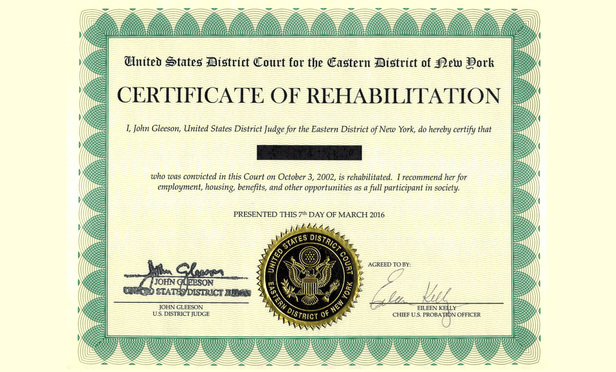
The New York Law Journal published an article over the weekend about the “novel relief” provided by the federal certificate of rehabilitation issued by former Judge John Gleeson on March 7, just days before he stepped down from the bench.  A reproduction of the certificate reveals its official appearance, complete with court seal and signatures of Judge Gleeson and the Chief U.S. Probation Officer.

certificate-of-rehabilitation

The government has until April 7 to appeal – the very day its appeal of Judge Gleeson’s expungement order in his first Jane Doe case will be argued in the Second Circuit.  The jurisdictional issues presented by the certificate order may be similar, if only because the certificate has some effect under state law.  See N.Y. Correct. Law §§ 703(7), 752, both cited in Judge Gleeson’s opinion.  It is likely that others similarly situated will apply for similar relief.

Read more

Judge Gleeson issues a “federal certificate of rehabilitation”

In his final week on the bench, in an opinion that may in time prove among his most influential, U.S. District Judge John Gleeson issued a “certificate of rehabilitation” to a woman he had sentenced 13 years before.  See Jane Doe v. United States, No. 15-MC-1174 (E.D.N.Y., March 7, 2016) (Jane Doe II).  The opinion breaks new ground in holding that federal courts have authority to mitigate the adverse effects of a criminal record short of complete expungement.  Along the way, it confirms that a district court may use its inherent equitable powers to expunge convictions in “extreme circumstances,” an issue now on appeal to the Second Circuit in Judge Gleeson’s earlier expungement case.  (Jane Doe I has been calendared for argument on April 7.)  The opinion also finds a role for federal probation to play, including under New York State’s “robust” certificate system, which lifts mandatory state law bars to employment and other opportunities.  It does all of this in a manner that should make it hard for the government to appeal, since “this court-issued relief aligns with efforts the Justice Department, the President, and Congress are already undertaking to help people in Doe’s position shed the burden imposed by a record of conviction and move forward with their lives.”    

Joe Palazzolo at the Wall Street Journal blog noted that  

More than a dozen states and the District of Columbia issue certificates to certain ex-offenders who have shown their days of crime are behind them, usually by remaining offense-free for a long stretch. . . . . 

There is no equivalent federal certificate. So Judge Gleeson invented his own.

Read more

50-state guide to expungement and sealing laws

The 50-state chart of judicial relief mechanisms from the NACDL Restoration of Rights Resource, which is also posted on this site, is a comprehensive survey of all authorities for judicial relief in the states and federal system. We wanted to bring it to our readers’ attention in light of the new federal interest in helping individuals with a criminal record overcome barriers to employment and licensing through clearing their records.

The National Clean Slate Clearinghouse, recently announced as part of President Obama’s reentry initiative, will “provide technical assistance to local legal aid programs, public defender offices, and reentry service providers to build capacity for legal services needed to help with record-cleaning, expungement, and related civil legal services.” This joint project of the Labor and Justice Departments will doubtless make it a first priority to survey the laws providing judicial and other relief in different states, to determine what sort of assistance lawyers will need to neutralize the adverse employment consequences of conviction, though the courts or otherwise.  We hope these resources will prove useful in that effort.

Read more