New 2019 laws restore voting rights in 11 states

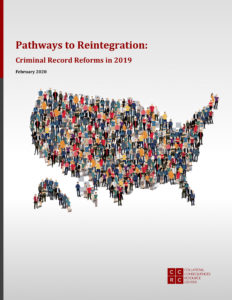
This is the first in a series of comments describing some of the 153 laws passed in 2019 restoring rights or delivering record relief in various ways.  The full report on 2019 laws is available here.

Restoration of Civil Rights

  1. Voting 

In 2019, eleven states took steps to restore the right to vote and to expand awareness of voting eligibility.  Our experience is that many people convicted of a felony believe they are disqualified from voting when they are not:  almost every state restores voting rights automatically to most convicted individuals at some point, if they are even disenfranchised to begin with.

The most significant new re-enfranchisement laws were enacted in Colorado, Nevada and New Jersey, where convicted individuals are now eligible to vote except when actually incarcerated.  Colorado restored the vote to persons on parole supervision, while Nevada revised its complex system for restoring civil rights so that all people with felony convictions may now vote except while in prison.  In one of the final legislative acts of 2019, New Jersey’s governor signed a law limiting disenfranchisement to a period of actual incarceration, even in cases where a court has ordered loss of the vote for election law violations, immediately restoring the vote to 80,000 people.  These three states joined the two states (New York and Louisiana) that in 2018 took steps to limit disenfranchisement to a period of incarceration:  New York’s governor issued the first of a series of executive orders under his pardon power restoring the vote to individuals on parole, and Louisiana passed a law allowing people to register if they have been out of prison for at least five years.

Now, only three of the 19 states that disenfranchise only those sentenced to prison still extend ineligibility through completion of parole:  California, Connecticut, and Idaho.  Bills under consideration in 2019 in both California and Connecticut would allow people to vote once they leave prison, though in California this will require a constitutional amendment.

Kentucky saw perhaps the most dramatic extension of the franchise in 2019, when its incoming governor Andy Beshear issued an executive order restoring the vote and eligibility for office to an estimated 140,000 individuals convicted of non-violent felonies who had completed their sentences.  Before the order, individuals were required to petition the governor individually to obtain restoration of their voting rights.  (Governor Beshear’s father had issued a similar order in 2015 at the end of his own term as governor, but it was revoked by his successor.)  Iowa is now the only state that does not restore the vote automatically to most convicted individuals at some point.

Read more

Broken records: criminal history errors cost jobs and housing

Ariel Nelson of the National Consumer Law Center has authored an important new report, Broken Records Redux, which describes how errors by criminal background check companies harm consumers seeking jobs and housing.  In particular, the report shows how background screeners continue to include sealed and expunged records in criminal background check reports, omit disposition information, misclassify offenses, mismatch the subjects of records, and include other misleading information.  The report also examines problems arising from the use of automated processes to evaluate prospective employees and tenants.

This report, a sequel to a 2012 NCLC report on criminal background errors, observes that since 2012 advocates and federal agencies have litigated many actions for violations of the Fair Credit Reporting Act (FCRA), leading to settlements and judgments requiring background screeners to reform their processes and pay millions in penalties and relief to consumers.  Despite these lawsuits, “companies continue to generate inaccurate reports that have grave consequences for consumers seeking jobs and housing.”  Based on these issues, the report recommends a broad array of legislative and regulatory changes at the federal and state level.  Accompanying the report is an article: Fertile Ground for FCRA Claims, which describes FCRA violations that can result from “inaccurate, incomplete, or outdated” background checks.

This new report also provides support for policy recommendations in our recently released Model Law on Non-Conviction Records, including restrictions on the dissemination of expunged records and records indicating no disposition by commercial providers of criminal records.

“For expungement and clean slate laws to succeed in removing barriers to employment and housing, they must take into account issues like background check reporting, data aggregation, and the use of stale data,” says Nelson, the author of the NCLC report. “I’m happy to see that CCRC’s Model Law on Non-Conviction Records provides guidance for addressing those issues.”

Fair Chance Act advances in Congress

NOTE:  The Fair Chance Act was signed into law on December 20, 2019, as Public Law 116-92, but its provisions will not take effect for a two-year period after enactment. 

The Fair Chance to Compete for Jobs Act of 2019 passed the House on December 11 and the Senate on December 17 with bipartisan support, as part of the National Defense Authorization Act of 2020.  If signed into law, this would be the first piece of federal legislation in over a decade to provide a degree of relief from discrimination based on criminal record.

The Fair Chance Act would amend Titles 2, 5 and 28 of the U.S. Code to prohibit employers in all three branches of the federal government, and private-sector federal contractors, from asking about job applicants’ arrest and conviction record until a conditional offer of employment has been extended, an approach that has become known as “ban the box.”

“By requiring employers to hold off on asking job applicants about their conviction records until after a conditional job offer has been made, more than 700,000 Americans will gain a fairer chance at finding employment and securing a better future for themselves and their families,” said Maurice Emsellem, fair chance program director with the National Employment Law Project (NELP).

The Act’s prohibition on pre-offer inquiries extends to “criminal history information,” which is defined to include records that have been “sealed or expunged pursuant to law,” and sealed records of juvenile adjudications.  See proposed 5 U.S.C. § 9201(4)(B) and (C).  Certain types of employment would be excepted, including employment that otherwise requires inquiry into criminal history, and employment in the military, in law enforcement, and in national security.  The Director of OPM is permitted to designate additional exemptions, including positions that involve “interaction with minors, access to sensitive information, or managing financial transactions.”  See proposed § 9202(B) and (C).  The law contains provisions for enforcement and sanctions.

In additional to extending ban-the-box requirements to employment on federal contracts, including defense contracts, it would also prohibit agency procurement officials from asking persons seeking federal contracts and grants about their criminal history, until an “apparent award” has been made.  It is not clear how this law will apply where agency regulations rather than statutes govern consideration of conviction in the award of contracts and grants.

Presumably, once a conditional offer of employment has been extended, the Act would permit agencies and contractors to inquire into the applicant’s criminal history under other applicable authority.  For federal executive agencies, general authority to conduct background checks (“for national security and other purposes”) is in 5 U.S.C. §  9101.  This section authorizes inquiry about “arrests, indictments, informations, or other formal criminal charges, and any disposition arising therefrom,” as well as “records of a State or locality sealed pursuant to law if such records are accessible by State and local criminal justice agencies for the purpose of conducting background checks.”  5 U.S.C. §9101(a)(2).  Thus, post-offer, it would appear that non-conviction records could continue to be the subject of inquiry by federal hiring and contracting authorities, as well as any records that have been sealed or expunged – but only if they are available to criminal justice agencies for background checks.  (The Fair Chance Act states that it does not authorize post-offer inquiry into the broader set of records “sealed or expunged pursuant to law” or juvenile records that would be specifically barred from pre-offer inquiry under § 9201.  See proposed 5 U.S.C. §  9206.)  In some states, including New York and Texas, sealed or expunged non-conviction records are not available to law enforcement for any purpose without a court order, in others such records are available for law enforcement hiring only, and in still others there are no limits on law enforcement access. Our model law on non-conviction records notes that the states are roughly split on the question of routine law enforcement access to expunged or sealed records, and the question appears to be one on which there are valid arguments to be made for either position.

Perhaps, Congress will next take up the question of how agencies and contractors should consider any criminal history that is revealed after inquiry is permitted, including non-conviction records that have been expunged or sealed or convictions that have been pardoned.  In this regard, only a minority of states that have enacted ban-the-box laws also have enforceable hiring standards or fair employment laws that bar discrimination based on criminal record.  However, among the many benefits of ban-the-box laws is the accountability that comes with knowing that employers will now no longer be possible to hide the fact an applicant’s rejection is based on their criminal record.  If adverse decisions must be defended, there should be far fewer of them.

Model law proposes automatic expungement of non-conviction records

An advisory group drawn from across the criminal justice system has completed work on a model law that recommends automatic expungement of most arrests and charges that do not result in conviction.  Margaret Love and David Schlussel of the Collateral Consequences Resource Center served as reporters for the model law.  It is available in PDF and HTML formats.

“Many people may not realize how even cases that terminate in a person’s favor lead to lost opportunities and discrimination,” says Sharon Dietrich, Litigation Director of Community Legal Services of Philadelphia, and one of the advisors of the model law project.  “Over the years, my legal aid program has seen thousands of cases where non-convictions cost people jobs.”

In proposing broad restrictions on access to and use of non-conviction records, the project aims to contribute to conversations underway in legislatures across the country about how to improve opportunities for people with a criminal record.  Already in 2019, states have enacted more than 130 new laws addressing the collateral consequences of arrest and conviction.  The group regards its model as the first step in a broader law reform initiative that will address conviction records as well.

Law enforcement officials make over 10 million arrests each year, a substantial percentage of which do not lead to charges or conviction.  Records of these arrests have become widely available as a result of digitized records systems and a new commerce in background screening and data aggregation.  These checks often turn up an “open” arrest or charges without any final disposition, which may seem to an employer or landlord more ominous than a closed case.

Very few states have taken steps to deal with the high percentage of records in repositories and court systems with no final disposition indicated.  Paul McDonnell, Deputy Counsel for New York’s Office of Court Administration and a project advisor, noted: “Criminal records that include no final disposition make it appear to the untrained eye that an individual has an open, pending case, which can have serious results for that person. New York has recently made legislative progress in addressing this problem, though more can be done.”

Current state and federal laws restricting access to and use of non-conviction records have limited application and are hard to enforce.  Eligibility criteria tend to be either unclear or restrictive, and petition-based procedures tend to be burdensome, expensive, and intimidating.  In recent years, lawmakers and reform advocates have expressed a growing interest in curbing the widespread dissemination and use of non-convictions, leading some states to simplify and broaden eligibility for relief, reduce procedural and financial barriers to access, and in a handful of states to make relief automatic.

Rep. Mike Weissman, a Colorado State Representative and model law project advisor, noted that Colorado has recently overhauled its laws on criminal records with broad bipartisan support.  “It is heartening to see similar reforms underway in other states, both red and blue, as well.  I commend the practitioners and researchers who helped formulate the model law for illustrating avenues for further progress in reducing collateral consequences.”

The model law would take this wave of criminal record reforms to a new level.  It recommends that expungement be immediate and automatic where all charges are terminated in favor of an accused.  Uncharged arrests should also be automatically expunged after a brief waiting period, as should dismissed or acquitted charges in cases where other charges result in conviction.  Cases that indicate no final disposition should also be expunged, unless there is indication that they are in fact pending.

The model law also recommends that expunged non-conviction records should not be used against a person in a range of criminal justice decisions, including by law enforcement agencies.  It would prohibit commercial providers of criminal background checks from disseminating expunged and dated non-conviction records, and civil decision-makers from considering them.

David LaBahn, President of the national Association of Prosecuting Attorneys, indicated that organization’s support for the model law, stating that the collateral consequences of non-convictions “do not serve to make the community safer,” and that “the current structures in place to expunge a non-conviction record can be confusing and difficult for the layperson to navigate alone.”

This model law sets the stage for jurisdictions to address record relief for convictions more generally, and its structure and principles can be brought to bear on that important work.

The Collateral Consequences Resource Center organized this model law project.  An early draft of the model law was discussed at an August 2019 Roundtable conference at the University of Michigan that was supported by the Charles Koch Foundation.  The model law report was supported by Arnold Ventures.

Read the model law in PDF or HTML.

Ohio governor establishes expedited pardon process

On December 3, Governor Mike DeWine announced an initiative that promises to revive the pardon power in Ohio and bring much-needed relief from collateral consequences to many hundreds of deserving individuals convicted over the years in that state.  The Expedited Pardon Project, a collaboration between the Governor’s Office and the Drug Enforcement Policy Center at Ohio State University and the Reentry Clinic at The University of Akron School of Law, aspires to expedite the process by which people apply for a pardon under Ohio’s laws by enlisting law students to assist in preparing pardon applications.  Once petitions are filed, the formal pardon process prescribed by statute will be collapsed into a period of months, with final action by the governor in less than a year.

This initiative could elevate Ohio into the small group of states that have productive and regular pardon programs, including states like Connecticut, Delaware, Georgia and South Carolina, where duly constituted pardon boards (some entirely independent of the governor) preside over programs that issue hundreds of pardons every year, granting relief to a high percentage of individuals that apply.  Another handful of states, including Arkansas, Nebraska, and Nevada, have somewhat smaller pardon programs but still issue between 50 and 100 grants each year.  With this expedited initiative, Ohio could quickly join their ranks, supplementing the state’s limited judicial sealing and certificate laws in furthering the goals of restoration and reintegration.  It could also make the Ohio pardon process one of the most efficient in the nation.

Read more