Author: CCRC Staff

Editorial staff of the Collateral Consequences Resource Center

“Executive Clemency in the United States”

This is the title of CCRC Executive Director Margaret Love’s new article for the Oxford Research Encyclopedia.  The article describes the historic role played by the executive pardon power in reducing punishments (including collateral ones) and explains clemency’s diminished vitality and reliability in modern times in most states and in the federal system.  Love concludes that “[i]t appears unlikely that an unregulated and unrestrained executive power will ever be restored to its former justice-enhancing role, so that those concerned about fairness and proportionality in criminal punishments must engage in the more demanding work of democratic reform.”

Here’s the abstract:

Read more

Federal farm bill legalizes hemp, but bars participation based on criminal record

In the past six years, almost every state has taken at least some steps to chip away at the negative effects of a criminal record on a person’s ability to achieve employment, housing, education and public benefits, and participation in civil society.  In stark contrast, Congress has not dealt with the problem of reintegration for more than a decade—either by reducing federal collateral consequences or by restoring rights to people with federal convictions.  The new farm bill continues this trend.

Enacted on December 20, 2018, the bill puts in place a new regulatory regime for the legalized cultivation and sale of hemp, a variety of the cannabis plant grown for industrial uses.  At the same time, the bill adds a new collateral consequence to federal law (which already has more than a thousand): anyone convicted of a drug-related felony may not participate in legalized hemp production for 10 years after their date of conviction, unless they are part of a hemp pilot program authorized by the 2014 farm bill.  An earlier version of the farm bill would have banned people with drug-related felony convictions from participating in hemp production for life, so the final bill is somewhat more progressive.

This new restriction reflects and contributes to an ongoing practice in which many jurisdictions that have legalized marijuana have excluded people with marijuana convictions from participating in this booming new industry.  Moving in the other direction, some jurisdictions such as California and Massachusetts—recognizing racial disparities and other injustices of the war on drugs—have enacted policies to clear marijuana convictions, allocate marijuana tax revenue to communities disproportionately affected by past drug policies, and encourage full participation in legalized marijuana industries by members of disproportionately affected communities.

“Wealth-Based Penal Disenfranchisement”

This is the title of an important new article by Professor Beth Colgan, forthcoming in the Vanderbilt Law Review, in which she documents how inability to pay economic sanctions associated with a criminal conviction (such as fines, fees and restitution) results in continuing disenfranchisement nationwide.  While the law in almost every state now restores the vote to those convicted of felonies no later than completion of sentence, and while fewer than a dozen states explicitly condition re-enfranchisement upon payment of court-imposed debt, Colgan shows how the link between re-infranchisement and conditions of supervision “significantly expands the authorization of wealth-based penal disenfranchisement across the country.”  Through a detailed analysis of interrelated laws, rules, policies and practices, including those related to conditions of probation and parole, she establishes that “wealth-based penal disenfranchisement is authorized in forty-eight states and the District of Columbia.”

After describing the mechanisms of wealth-based penal disenfranchisement, Colgan offers a legal theory for “dismantling” them.  She argues that courts have looked at these mechanisms “through the wrong frame—the right to vote—when the proper frame is through the lens of punishment.”  Applying the doctrine developed in cases restricting governmental action that would result in disparate treatment between rich and poor in criminal justice practices, she concludes that wealth-based penal disenfranchisement violates the Fourteenth Amendment.

The article’s abstract follows:

Read more

Press release: New report on 2018 fair chance and expungement reforms (updated)

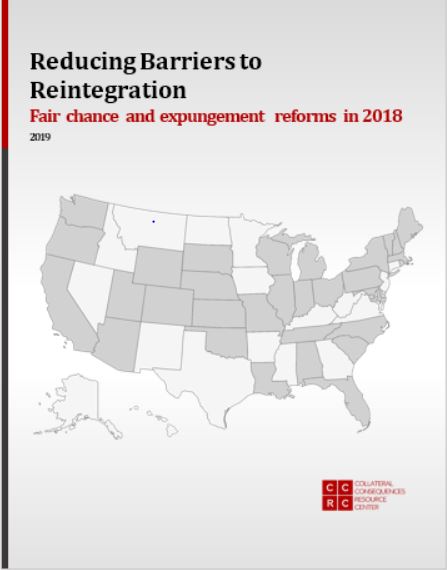
Washington, D.C. — The Collateral Consequences Resource Center (CCRC) has released a new report documenting the extraordinary number of laws passed in 2018 aimed at reducing barriers to successful reintegration for individuals with a criminal record.  In the past twelve months, 32 states, the District of Columbia, and the U.S. Virgin Islands have enacted 61 new laws aimed at avoiding or mitigating the collateral consequences of arrest and conviction, consequences that may otherwise last a lifetime.  The CCRC report analyzes the past year’s lawmaking and summarizes all 61 new authorities, which include 57 statutes, 3 executive orders, and one ballot initiative.  The report, titled “Reducing Barriers to Reintegration: Fair chance and expungement reforms in 2018,” is available to download here

Last year saw the most productive legislative year since a wave of “fair chance” reforms began in 2013.  CCRC documented these earlier developments in reports on the 2013-2016 reforms and 2017 reforms.  In the period 2012–2018, every state legislature has in some way addressed the problem of reintegration.  Congress has not enacted any laws dealing with the problems presented by collateral consequences for more than a decade.

The state laws enacted in 2018 aim to break down legal and other barriers to success in the courts, the workplace, the pardon process, and at the ballot box:

Read more

New edition of collateral consequences treatise now available

The 2018-2019 edition of the West/NACDL treatise on collateral consequences is now available for purchase, at a publisher’s promotional discount. Wayne A. Logan has joined Margaret Love and Jenny Roberts as a co-author of this comprehensive resource: Collateral Consequences of Criminal Conviction: Law, Policy & Practice.

This third edition of the treatise has been entirely updated, and includes new material on regulation of criminal background checking; consideration of collateral consequences in the criminal case; laws providing for restoration of rights and status, including in employment and occupational licensing; and, recent court decisions on sex offender registration and related penalties.  Appendices include detailed state-by-state analysis of restoration laws, and other primary source materials.  The full table of contents for this 1048-page book is available here. 

The publisher describes the book as follows: 

Today, many millions of Americans have a criminal record of some kind, potentially triggering a vast array of highly burdensome and stigmatizing consequences that can have life-long debilitating effects. This volume provides comprehensive discussion and analysis of these after-effects of the nation’s ongoing “tough on crime” policies, ranging from loss of civil rights and employment opportunities, to registration and residency restrictions.  It serves as a single go-to resource for practicing lawyers, judges, and policymakers as they negotiate the often-complex and sometimes-obscure statutes and regulations that come into play as a result of arrest and conviction.

Highlighted features:

  • Describes specific types of consequences, including firearms dispossession, licensing and contracting bars, travel restrictions, immigration consequences, and sex offender registration
  • Addresses legal and ethical duties of counsel and courts
  • Analyzes constitutional law aspects of collateral consequences
  • Explains varied methods of rights restoration and preservation in different U.S. jurisdictions
  • Covers criminal practice-related issues (charging, negotiating pleas, sentencing, appeals and collateral relief)
  • Addresses access to criminal records and regulation of criminal background checking
  • Discusses current and possible future law reform efforts (ALI/MPC, state initiatives, etc.)

Appendices contain summaries of state and federal laws on restoration of and status, and key documents on law reform proposals.

The book is available for purchase, currently at a discounted price of $186.30 for paperback or e-book (though the discounted rate may not be shown on the West catalogue page).  For the discounted rate, please call the publisher at 800-328-9352, and press “2” to place an order.

The book is also available on-line on Westlaw.  Endorsements from Bryan Stevenson, Jeremy Travis, Judge John Gleeson, and Jo-Ann Wallace can be seen here.