Professors Sonja B. Starr and J.J. Prescott of Michigan Law School have released the first-ever broad-based empirical study of the effects of a state law limiting public access to criminal records. CCRC’s reports have noted the lack of empirical research to inform policies aimed at promoting reentry and reintegration for people with a criminal record—something this study of Michigan’s set-aside law begins to correct. As its authors observe, “Despite the considerable legislative ferment and the excitement that surrounds ‘clean slate’ initiatives in the civil rights and criminal justice reform worlds, what has been missing from the debate is hard evidence about the effects and true potential of conviction expungement laws.” A reason for this, as the authors also note, is that by definition criminal records that are the subject of sealing or expungement relief are often unavailable to study. [Note: In the summer of 2019, the study was accepted for publication in the Harvard Law Review.]
Using a data-sharing agreement with multiple Michigan state agencies, Starr and Prescott completed an extensive statewide analysis of expungement of criminal convictions in Michigan over the course of decades. Their analysis reveals three key findings:
- Uptake: Just 6.5% of those eligible for expungement successfully complete Michigan’s application process within five years of eligibility.
- Recidivism: Expungement recipients “have extremely low subsequent crime rates, comparing favorably to the general population—a finding that defuses a common public-safety objection to expungement laws.”
- Employment: Expungement receipts see a “sharp upturn” in wage and employment: wages go up on average by 25% within two years, driven mostly by “unemployed people finding jobs and very minimally employed people finding steadier or higher-paying work.”
These conclusions just about cover the waterfront of findings we would most like to see about laws that limit public access to criminal records. Looking at them in reverse order, Starr and Prescott find that expungement is valuable in economic terms for those who receive this relief, and improvements in their economic status will in turn benefit their families and communities.
They also find that those who benefit from expungement present no particular threat to public safety, whether because recipients of expungement are self-selected criminal justice success, because the courts that grant them relief take their likelihood of reoffending into account, or because expungement itself does not tend to increase recidivism risk (and in fact may reduce it).
Finally, and perhaps most disturbingly, few of the people who are intended beneficiaries of Michigan’s expungement law actually obtain this relief, either because they don’t apply for it or because their applications for expungement are not approved. The authors find six reasons that account for this “uptake gap” (which is greater for people with misdemeanors than felonies):
- lack of information about the availability of relief;
- administrative hassle and time constraints;
- cost (including court filing fees, lost wages, and transportation costs);
- distrust and fear of the criminal justice system;
- lack of access to counsel; and
- insufficient motivation to remove conviction.
In addition, while not a part of the “uptake gap” strictly speaking, the authors note that “every advocate that we spoke to also emphasized the stringency of the eligibility requirements, which in their view exclude a great many worthy candidates.” (A person must have no more than one felony conviction and no more than two misdemeanor convictions in order to be eligible for “set-aside” under what is commonly known as the “general expungement statute.” In contrast to most states, however, most felony convictions are eligible for set-aside. A Michigan set-aside limits public access to the record, but it remains available to law enforcement and some other government agencies. See the description of Michigan’s law providing for set-aside in the Michigan profile from the Restoration of Rights Project.) The authors remark about the eligibility requirements for set-aside in Michigan:
All of these restrictions mean that the low uptake rate we estimated is even starker when viewed in context: it is a very small fraction of a very small fraction. For the past decade about two thousand set asides per year have been granted in Michigan. Meanwhile, each year the Michigan state courts add about 300,000 new criminal convictions. On balance, the population of people living with criminal records is continuing to grow quickly; the set-aside law is like a bucket removing water from an ever-rising ocean.
We note that Michigan’s eligibility requirements are actually more inclusive than those in most states. See this 50-state chart.
We expect that the findings of this remarkable new study will prove uniquely valuable to advocates and policy-makers considering changes to laws authorizing relief from collateral consequences in the days and years ahead.
Read more

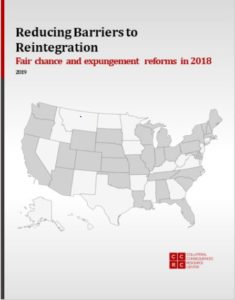 CCRC report analyzes last year’s lawmaking and summarizes all 61 new authorities, which include 57 statutes, 3 executive orders, and one ballot initiative.