Preliminary results of an empirical study by two University of Michigan law professors show that setting aside an individual’s record of conviction is associated with “a significant increase in employment and average wages,” and with a low recidivism rate. We know of only one other similar study, conducted by researchers at the University of California at Berkeley, and it came to essentially the same conclusion. One relevant difference between the two studies is that in Michigan set-aside results in sealing of the record, while in California it does not. Such studies are rare because of the difficulty of obtaining data, particularly where relief seals the record, but they are a very important way of advancing a reform agenda. Thus, Professors Sonja Starr and J.J. Prescott propose that their research “provides important empirical guidance to the broader social policy debates associated with set-aside laws and accessibility of criminal records.” In the hope that their work will encourage others to undertake similar research, we reprint the entire report below.
Read more
Category: Reports
New report: Roundup of 2017 expungement and restoration laws
A new report from the Collateral Consequences Resource Center shows that states across the country are continuing to expand opportunities to avoid or mitigate the adverse effects of a criminal record. If anything, the trend first documented last winter in Four Years of Second Chance Reforms, 2013 – 2016 has accelerated in 2017.
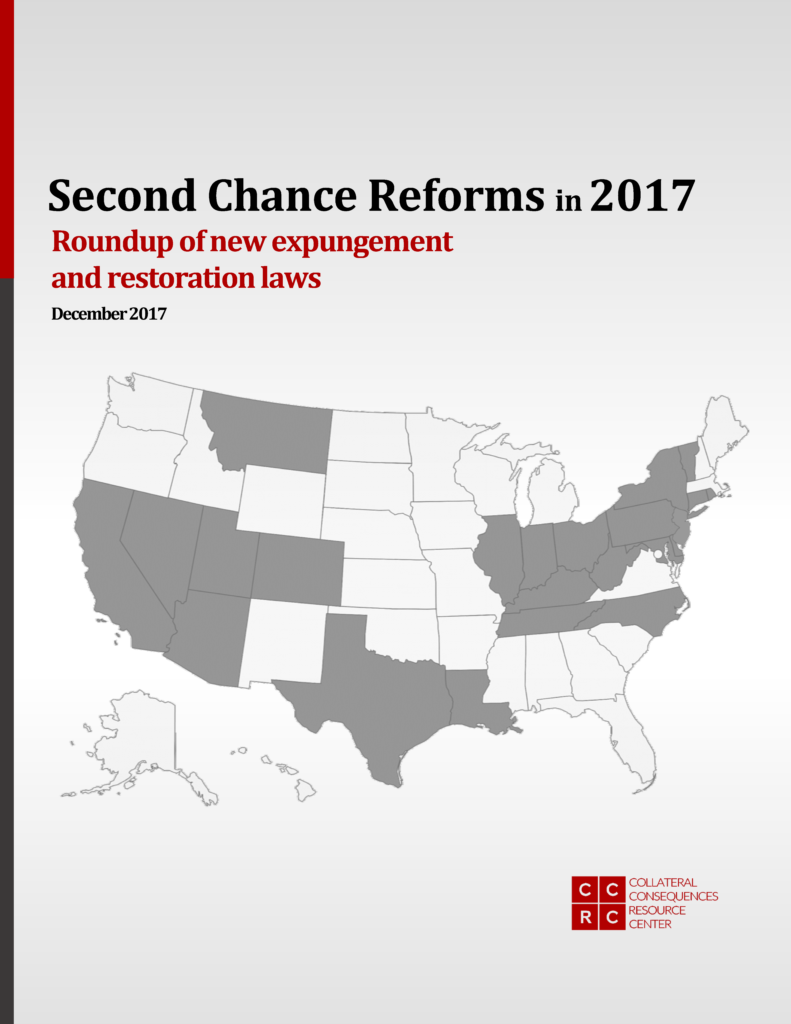 Second Chance Reforms in 2017 identifies 23 states, blue and red, that in the past year broadened existing second chance laws or enacted entirely new ones, enhancing the prospects for successful reentry and reintegration for many thousands of Americans. Using research from the Restoration of Rights Project, the report describes specific changes to the law in each state during the past year along with relevant citations, analyzing and comparing approaches taken by different states.
The most frequent type of reform involves limiting public access to criminal records: new sealing or expungement laws were enacted in several states that previously had none, eligibility requirements were relaxed for many existing record-sealing authorities, and new limits were imposed on access to non-conviction and juvenile records – all making it easier for more individuals to get relief at an earlier date. However, there is remarkably little consistency among state record-closing schemes, and most states extend relief only to less serious offenses after lengthy eligibility waiting periods. Moreover, eligibility criteria are frequently so complex as to defeat the sharpest legal minds. Other recurring reforms limit employer inquiries into criminal history at the application stage, and a few states enacted administratively enforceable standards for consideration of criminal history in employment and licensing.
The fast pace of reform in the states reflects a dawning realization that the problem of mass conviction is at least as significant in economic and social terms as the problem of mass incarceration. At the same time, the dizzying variety and complexity of the new provisions indicates that there is still no consensus about the most effective way to avoid or mitigate the adverse effects of a criminal record. Because there has been very little empirical research into the relative effectiveness of different forms of relief, it is not surprising that experimentation seems to be the order of the day.
These new laws and significant reform proposals of the past several years – notably the collateral consequences provisions of the Model Penal Code: Sentencing – will be discussed at a Roundtable conference in Washington, D.C. on January 12, 2018, sponsored by the American Law Institute and the National Conference of State Legislatures.
Each new reform is more fully explained in the state-by-state profiles in the Restoration of Rights Project. The Executive Summary follows, and the full report is available here.
Read moreNew report: 50-state guide to expungement and restoration of rights
CCRC is pleased to announce the publication of its 50-state guide  to expungement and restoration of rights: “Forgiving and Forgetting in American Justice.” This report catalogues and analyzes the various provisions for relief from the collateral consequences of conviction that are now operating in each state, including judicial record-sealing and certificates of relief, executive pardon, and administrative. Its goal is to facilitate a national conversation about how those who have a criminal record may best regain their legal rights and social status.
Given the millions of Americans who have a criminal record, and the proliferation of laws and policies excluding them from a wide range of opportunities and benefits, there is a critical need for reliable and accessible relief provisions to maximize the chances that these individuals can live productive and law-abiding lives after completion of their court-imposed sentences. Whatever their form, relief provisions must reckon with the easy availability of criminal records, and the pervasive discrimination that frustrates the rehabilitative goals of the justice system.
 It is not the report’s purpose to recommend any specific approach to relief. Rather, our goal is simply to survey the present legal landscape for the benefit of the policy discussions now underway in legislatures across the country. We are mindful of the fact that very little empirical research has been done to measure outcomes of the various schemes described, many of which are still in their infancy. It is therefore hard to say with any degree of certainty which approach works best to reintegrate individuals with a record into their communities. At the same time, we hope that our description of state relief mechanisms will inform the work of lawyers and other advocates currently working to assist affected individuals in dealing with the lingering burdens imposed by an adverse encounter with the justice system.
Preview of 50-state report on effective relief mechanisms
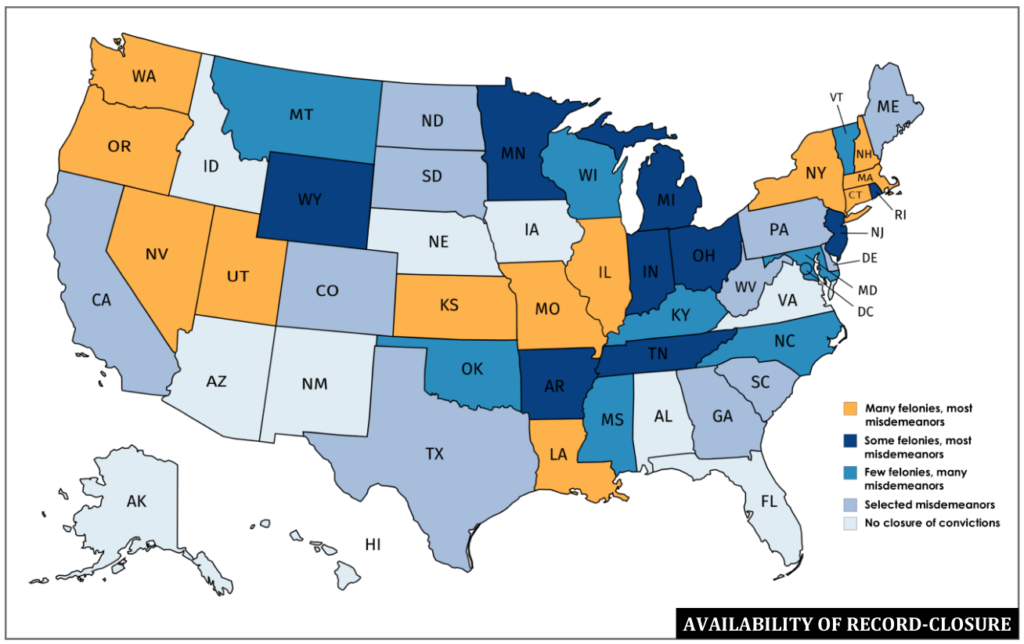
The Collateral Consequences Resource Center is currently finalizing a 50-state report on the availability of relief from the adverse civil effects of a criminal arrest or conviction. Using research from the Restoration of Rights Project (RRP), the report analyzes the data in several different categories, including executive pardon, judicial record-closing and certificates, and regulation of employment and licensing. It showcases those states that have the most comprehensive and effective relief mechanisms, and at the same time provides a snapshot of the extraordinary recent interest in restoration of rights and status in state legislatures across the country. It also looks at what states are doing to enable less serious offenders to avoid a criminal record altogether, through statutory deferred adjudication programs managed by the courts.
We preview here the report’s conclusions, illustrated by a series of color-coded maps that create a visual image of where people with a criminal record appear to have the best chance of regaining their rights and status through a variety of different relief mechanisms. The full report will be published shortly after Labor Day.
Table
4. Regulation of employment and licensing
5. Loss and restoration of voting rights
Read more“Back to Business” – A report on fair chance hiring policies
A new report examines successful efforts by corporations and government leaders to promote “fair chance” hiring policies for people with criminal histories. Back to Business: How Hiring Formerly Incarcerated Job Seekers Benefits Your Company reviews the latest research on the effect of a criminal record on employment interviews and on the job performance of workers with such records. The report summary continues:
Several case studies presented here show how fair chance policies can promote loyalty and stability in the labor pool. The report provides a roadmap for businesses seeking to create and sustain fair chance policies, including “banning the box,” or removing criminal history questions from job applications. It explains how hiring officers can effectively carry out this policy, and how to choose background check companies that use best practices in data collection. It analyzes racial bias that has been connected with “ban the box” policies, and how to eliminate such bias by training administrators involved in hiring processes. The report also outlines compliance requirements with federal equal employment rules as they apply to people with criminal records. And it examines the issue of negligent hiring liability and how to avoid such liability. Education is critical to job readiness, employee retention, and economic mobility. The costs of re-incarceration far exceed the costs of correctional education, and access to training and higher education have been shown to reduce recidivism and increase the likelihood of employment upon release. One case study describes how one college is developing inprison education programs under a federal pilot program and offers a model for making correctional education scalable. The report examines how partnering with workforce training and development programs can help employers succeed with employees who have been in prison. Many workforce development agencies offer training and counseling tailored to help these individuals transition into jobs. Lastly, the report provides recommended actions that businesses can take to create a fair chance for all.
The report was prepared by the Trone Private Sector and Education Advisory Council to the American Civil Liberties Union, with its partner organizations the Legal Action Center, the Lawyers Committee for Civil Rights Under Law, and the National Workrights Institute.
Read moreRestoration of Firearm Rights After Conviction: A National Survey and Recommendations for Reform (Dec. 2025)

Positive Credentials That Limit Risk: A Report on Certificates of Relief (June 2024)

Advancing Second Chances: Clean Slate and Other Record Reforms in 2023 (Jan. 2024)

Accessing SNAP and TANF Benefits after a Drug Conviction: A Survey of State Laws (Dec. 2023)
The Many Roads from Reentry to Reintegration (March 2022)