As the presidential pardon of everyone’s favorite Thanksgiving galliformes makes front-page news across the country (a tradition that the many human clemency petitioners who have spent years awaiting action must struggle to find the whimsy in), two law professors take the federal clemency system to task in a new Washington Post opinion piece. In the piece, professors Rachel E. Barkow (NYU) and Mark Osler (University of St. Thomas) argue that the long and multi-tiered review process for federal clemency petitions could be significantly improved if the president would minimize the Justice Department’s involvement in the process while shifting responsibility to a bi-partisan review commission. From the article:
Read moreCategory: Policy
Ohio’s on-line inventory of collateral consequences – a useful tool for defense lawyers
Kelley Williams-Bolar was a single mother in Akron Ohio, a teacher’s aide who was studying to become a teacher herself. Her story made headlines in 2011, when she was accused of misusing her father’s home address to enroll her two young daughters in a public school they were not entitled to attend. After her own home was burglarized, Kelley had enrolled the girls in their grandfather’s school district, so they could spend each afternoon after school safely at their grandfather’s house. To make this possible she had signed a “grandparent affidavit” saying that the girls lived with their grandfather. The new school district ultimately rejected the affidavit, and she withdrew the girls from t heir new school at the end of the school year.
Ohio’s “grandparent affidavit” form contains a printed warning, advising that anyone who submits a false affidavit can be charged with “Falsification, a first degree misdemeanor.” But that warning gave no hint of what would actually happen to Kelley. Eighteen months after her daughters left the new school, the district attorney charged Kelley with felony Grand Theft, claiming she had “stolen” tens of thousands of dollars’ worth of tuition for her children.
Particularly given Kelley’s career aspiration to be a teacher, her defense lawyer could have made good use of a new online resource called CIVICC (Civil Impacts of Criminal Convictions), a computerized compendium of state collateral consequences linked to the crimes that trigger them. (Kelley’s felony conviction was eventually reduced to a misdemeanor by Governor John Kasich, high level intervention that cannot be counted on to substitute for effective advocacy.)
At the CIVICC website, counsel in a case like Kelley’s could run a quick search using the keyword “theft,” and learn right away that conviction on the Grand Theft charge would expose her to 509 possible collateral consequences (“civil impacts”) under Ohio law, burdens she would bear long after her criminal sentence was complete.
Read moreNew reports evaluate national policy on juvenile record confidentiality
This month the Juvenile Law Center released an impressive pair of reports evaluating national policy on public access to juvenile criminal records. The first report, Juvenile Records: A National Review of State Laws on Confidentiality, Sealing and Expungement, provides a national overview of state laws, and proposes standards to mitigate exposure to collateral consequences as a result of a juvenile record.  The report also makes recommendations for policy-makers, courts, defense attorneys, and youth-serving agencies. Supplementing the national overview are fact sheets on the law in each state, including the availability and effect of expungement or sealing, and an overview of the process for obtaining such relief. (These fact sheets can be found by clicking on the relevant state on the map here).
A second complementary report, Failed Policies, Forfeited Futures: A Nationwide Scorecard on Juvenile Records, scores each state on the degree to which it meets the Center’s ideal standards for juvenile record protection. The Center based its evaluation of the states on its “core principles for record protection” including:
Read moreThe Democrat who would be the “Reentry President”: James Webb
This week’s New Yorker features an article by Ryan Lizza about potential democratic candidates. One, James Webb, former U.S. Senator from Virginia, has a history of interest in prisons and reentry of people with convictions. The article states:
 “In the Senate, he pushed for creating a national commission that would study the American prison system, and he convened hearings on the economic consequences of mass incarceration. He says he even hired three staffers who had criminal records. ‘If you have been in prison, God help you if you want to really rebuild your life,’ Webb told me. ‘We’ve got seven million people somehow involved in the system right now, and they need a structured way to reënter society and be productive again.’ He didn’t mention it, but he is aware that the prison population in the U.S. exploded after the Clinton Administration signed tough new sentencing laws.”
Of course, reentry is not necessarily a partisan issue; President George W. Bush also cared about it, calling America “the land of second chance” in his 2004 State of the Union address, and signing into law the Second Chance Act. It will be interesting to see if prison spending and reentry become issues in the primaries or the general election.
Read moreLabels and stereotypes in the President’s immigration speech
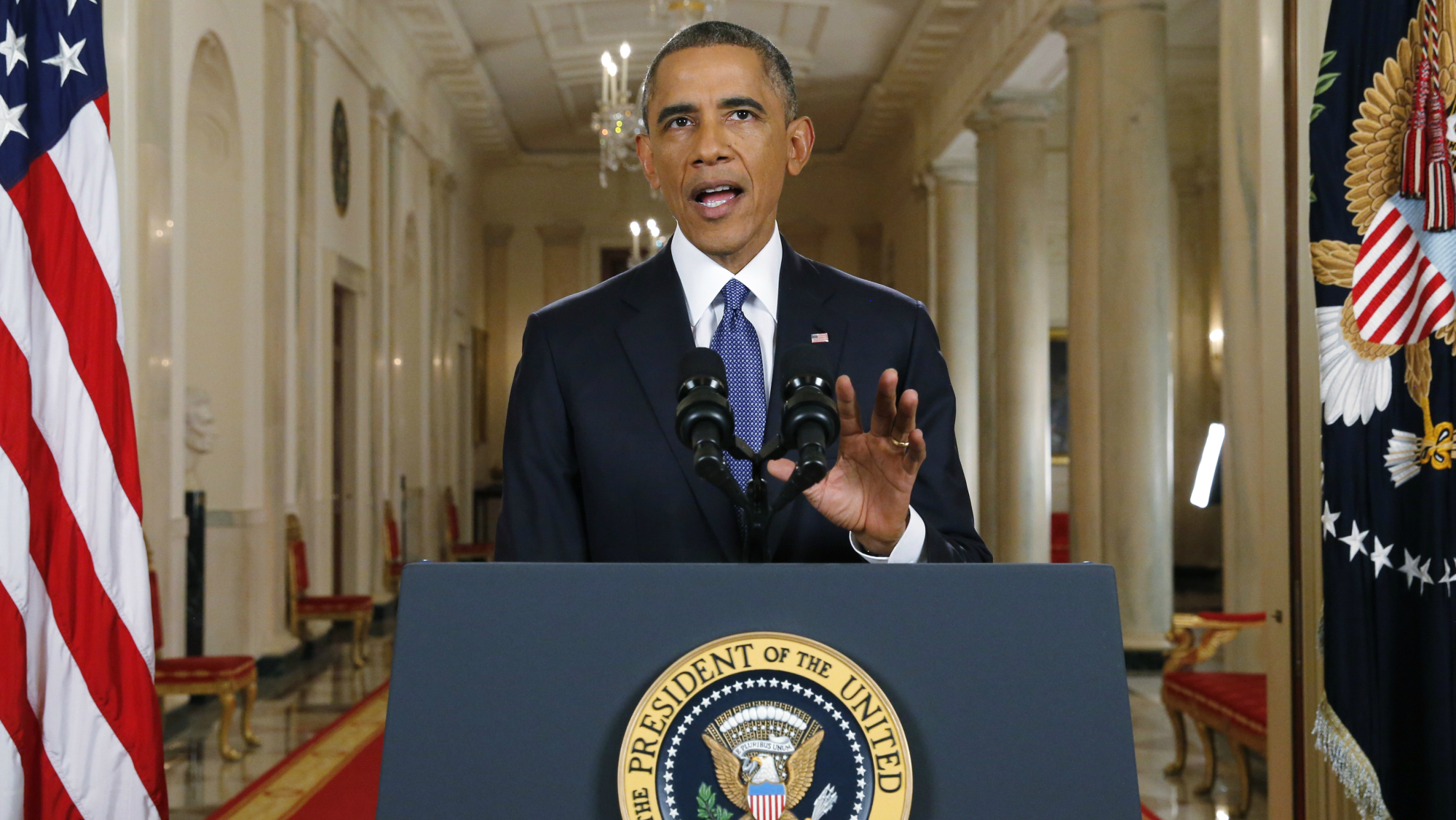 The President’s decision to take unilateral executive action to insulate certain undocumented immigrants from the immediate threat of deportation has provoked outrage in some quarters and profound relief in others. The legal issues raised by this decision are important and debatable, some of its line-drawing is problematic, and its success stands or falls on the uncertain terrain of bureaucratic discretion. No doubt its political implications are yet to be revealed.
But amid all the uncertainty, one thing is clear. In his speech announcing the initiative the President said, repeatedly and definitively, that no one with a criminal record would benefit from his reprieve. Thus, he emphasized that enforcement resources would remain focused on “actual threats to our security,” by which he meant “Felons, not families. Criminals, not children.” Again, it is possible to benefit from the law if you can “pass a criminal background check” (whatever that means), but “[i]f you’re a criminal, you’ll be deported.” Even people convicted of misdemeanors will not be spared under the new DHS enforcement priorities.
Entirely apart from the wisdom or fairness of the immigration policy choice involved in this broad blanket exclusion (and there are good reasons to be critical of it), it was disheartening to hear the President present it in such unfortunate language. The ugly labels of “felon” and “criminal” do, after all, at least technically describe a status shared by 25% of adult Americans. Labels like these serve only to demonize and exclude, and they are fundamentally at odds with our national policy of encouraging rehabilitation to reduce crime. There were other ways the President could have justified continuing his policy of deporting based on criminal record than by using words that do more to stir up fear of “the other” than to describe relevant functional attributes.
The President’s words suggest that people who have been convicted of a crime are evermore to be regarded as “felons” and “criminals,” categorically threatening to our safety and security, and uniformly deserving to be segregated and sent away. But he himself pardoned such a person less than two years ago, precisely to keep her from being deported. And he is surely aware of the bipartisan conversation now underway about the need to curb over-criminalization, one of the few matters on which Republicans and Democrats can agree. It is tempting to take linguistic shortcuts when politically expedient, but it is a temptation he might have resisted without jeopardizing his larger objective.
It is time we stopped using negative stereotypes and labels to describe people who at some point in their past have committed a crime, in the immigration context or otherwise. It is no longer acceptable to describe undocumented immigrants as “illegal aliens.” Our language needs a similar makeover where past convictions are concerned.
Read moreRestoration of Firearm Rights After Conviction: A National Survey and Recommendations for Reform (Dec. 2025)

Positive Credentials That Limit Risk: A Report on Certificates of Relief (June 2024)

Advancing Second Chances: Clean Slate and Other Record Reforms in 2023 (Jan. 2024)

Accessing SNAP and TANF Benefits after a Drug Conviction: A Survey of State Laws (Dec. 2023)
The Many Roads from Reentry to Reintegration (March 2022)