Category: Commentary

Should a criminal record ruin a career?

The Atlantic has published an excellent article about the permanently disabling effects of a criminal record, by two attorneys at the East Bay Community Law Center (Oakland, CA), Sarah Crowley and Alex Bender (an Equal Justice Works AmeriCorps Fellow).  Haunted by the Past: A Criminal Record Shouldn’t Ruin a Career, March 25, 2015.  The authors argue, based on their experiences in their practice, that “too many applicants, particularly people of color, are being denied jobs based on background checks that are irrelevant or even inaccurate.”   They describe the sources of inaccuracy and other unreliability in criminal background checks, even ones based on fingerprinting.  But then they focus on the real problem, which is that over-reliance on background checks “inevitably screens out qualified, trustworthy job applicants.” They tell the story of one woman whose dated misdemeanor convictions deprived a California group home of a valuable employee: 

Read more

New York Times editors question efficacy of expungement laws

In an editorial titled “Job Hunting With a Criminal Record,” the editors of the New York Times tackle the problem of employment discrimination against the estimated 70 million Americans who “carry the burden of a criminal record.”  They question the efficacy of expungement and other popular “forgetting” strategies for dealing with employer aversion to risk, preferring the “longer term” approach of “a change in attitudes about people with criminal records.” The editorial points out that expungement laws typically apply only to “relatively minor transgressions,” require lengthy waiting periods, and include “significant exceptions” (e.g., they don’t apply to jobs and licenses requiring a background check, a large and growing segment of the labor market). In addition, “trying to keep anything secret in the 21st century is no sure thing.”  Finally, “record-sealing laws do not and cannot address the underlying problem of overcriminalization.”

Read more

Forgiving v. forgetting: A new redemption tool

The following thought-provoking piece about the growing popularity of judicial “certificates of good conduct” was first published in The Marshall Project (www.themarshallproject.org) a nonprofit news organization focused on the US criminal justice system. The “forgiving” approach to avoiding or mitigating collateral consequences is an important alternative to the “forgetting” approach advocated by proponents of expungement or sealing, which tend in any event to be limited to minor dated offenses or arrests not resulting in conviction.         Forgiving v. Forgetting:  For offenders seeking a new life, a new redemption tool. In February of 2003, a much younger Barack Obama rose before the Illinois State Senate to introduce a new piece of legislation that, he said, contained a compromise. The bill would help job-seekers who had long ago been convicted of a nonviolent crime (or two, at most) overcome the barriers to employment that came with having a criminal history. But the bill would do so without expunging their records. Instead, Obama’s bill would create a final, years-later stage on the timeline of these ex-offenders’ cases. They had already completed the stages of arrest, booking, indictment, plea bargaining or trial, sentencing, incarceration and/or probation. Now, ex-felons who had stayed crime-free for a […]

Read more

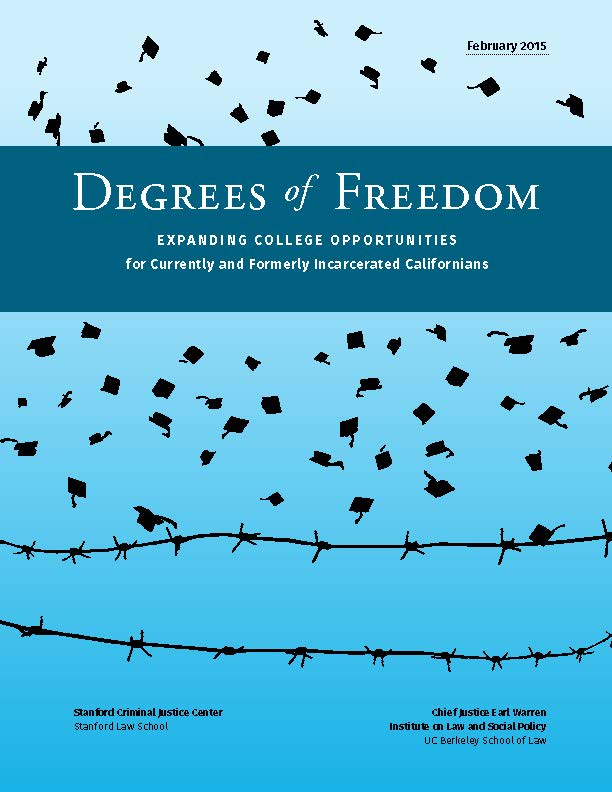
Expanding college opportunities for prisoners in California

Last week was an exciting one for proponents of the expansion of college opportunities for people who are currently incarcerated or who have criminal records.  Two reports were released that propose strategies to break the cycle of recidivism, promote public safety, and de-escalate mass incarceration by opening up post-secondary educational opportunities.  It is fitting that both reports come at a time when America is reflecting on the events of “Bloody Sunday” in Selma, Alabama, fifty years ago, and envisioning where the momentum of Black Lives Matter will take us.  It is the intersection of an historic civil rights struggle, the human rights movement that confronts “mass criminalization” and the racial divide in the U.S. today. The Stanford Criminal Justice Center and the Warren Institute at the UC Berkeley School of Law issued a report from the Renewing Communities Initiative, Degrees of Freedom: Expanding College Opportunities for Currently and Formerly Incarcerated Californians.  It was released just days after the Center for Community Alternatives (CCA) in cooperation with the Education from the Inside Out Coalition (EIO Coalition), issued its report, Boxed Out: Criminal History Screening and College Application Attrition, the subject of an earlier post on March 4, 2015.  

Read more

Does discrimination based on criminal record make good business sense?

During the week of February 2, Professor James Jacobs posted a series of opinion pieces on The Volokh Conspiracy blog to promote his new book on criminal records.  The basic argument advanced in these pieces, which condense the final two chapters of the book, is that “criminal record based employment discrimination is neither immoral nor illegal.”  While I am not a lawyer, and leave it to my colleagues Sharon Dietrich and Adam Klein to speak to the legal arguments in Professor Jacobs’ pieces, I believe I can speak to the public policy implications (if not the morality) of his position.  That I myself have a criminal record, am now an employer, and have spent 13 years since exiting prison working on these policy issues, ought to be considered by anyone who reads what I have to say.

Read more