A local office of the Wisconsin State Public Defender recently assisted two former clients who encountered obstacles with their respective legal and medical careers (minor details have been changed to ensure client confidentiality). These examples show that old criminal cases, even for relatively minor charges, can cause employment difficulties and frustrate professional advancement many years later. The first former client recently passed an out-of-state bar examination, and he disclosed on his license application a 20-year-old Wisconsin misdemeanor charge. When he called for assistance in interpreting the online court records, he learned (to his relief) that what he had always thought was a criminal conviction had actually been reduced to a non-criminal ordinance violation. Although the original criminal charge remains accessible in Wisconsin’s court records, he was able to amend his license application to report that he does not have any criminal conviction record. (It is not clear what effect a misdemeanor conviction would have had on his licensure, but now he won’t have to find out.)
Read moreTag: medical license
Restoration of Rights Project (RRP)
- Loss & restoration of civil/firearms rights
- Pardon policy & practice
- Expungement, sealing & other record relief
- Criminal record in employment, licensing & housing
RRP: State-By-State Guides
RRP: 50-State Comparisons
Restoration of Firearm Rights After Conviction: A National Survey and Recommendations for Reform (Dec. 2025)

50-state comparisons
About the Restoration of Rights Project
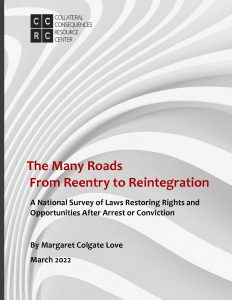
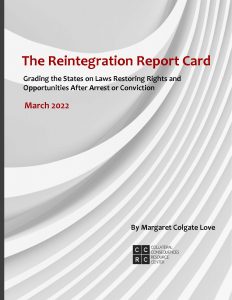
The Restoration of Rights Project (RRP) is a project of the Collateral Consequences Resource Center in partnership with the National Association of Criminal Defense Lawyers, National Legal Aid & Defender Association, National HIRE Network, Association of Prosecuting Attorneys, and Paper Prisons Initiative. Launched in 2017, the RRP is an online resource containing detailed state-by-state analyses of the law and practice in each U.S. jurisdiction relating to restoration of rights and status following arrest or conviction. Jurisdictional “profiles” cover areas such as loss and restoration of civil rights and firearms rights, judicial and executive mechanisms for avoiding or mitigating collateral consequences, and provisions addressing non-discrimination in employment, licensing, and housing. In addition to the jurisdictional profiles, RRP materials include a set of 50-state comparison charts that make it possible to see national patterns in restoration laws and policies. Short “postcard” summaries of the law in each state serve as a gateway to the more detailed information in the profiles, and provide a snapshot of applicable law in each state.
Originally published in 2006 by CCRC Executive Director Margaret Love, the research in the RRP has been kept up to date and substantially expanded over the years, and it is summarized in an appendix to the treatise on collateral consequences published jointly by NACDL and Thompson Reuters (West). It is intended as a resource for practitioners in all phases of the criminal justice system, for courts, for civil practitioners assisting clients whose court-imposed sentence has exposed them to additional civil penalties, for policymakers and advocates interested in reentry and reintegration of convicted persons, and for the millions of Americans with a criminal record who are seeking to put their past behind them.
These resources may be republished as long as appropriate attribution is given to the RRP as its source.