Tag: Jenny Roberts

New edition of collateral consequences treatise now available

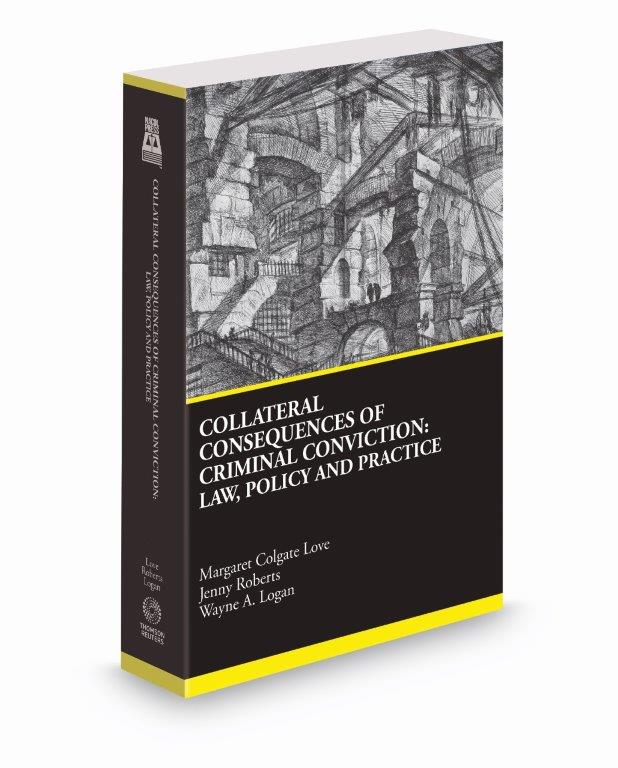
The 2018-2019 edition of the West/NACDL treatise on collateral consequences is now available for purchase, at a publisher’s promotional discount. Wayne A. Logan has joined Margaret Love and Jenny Roberts as a co-author of this comprehensive resource: Collateral Consequences of Criminal Conviction: Law, Policy & Practice. This third edition of the treatise has been entirely updated, and includes new material on regulation of criminal background checking; consideration of collateral consequences in the criminal case; laws providing for restoration of rights and status, including in employment and occupational licensing; and, recent court decisions on sex offender registration and related penalties.  Appendices include detailed state-by-state analysis of restoration laws, and other primary source materials.  The full table of contents for this 1048-page book is available here.  The publisher describes the book as follows:  Today, many millions of Americans have a criminal record of some kind, potentially triggering a vast array of highly burdensome and stigmatizing consequences that can have life-long debilitating effects. This volume provides comprehensive discussion and analysis of these after-effects of the nation’s ongoing “tough on crime” policies, ranging from loss of civil rights and employment opportunities, to registration and residency restrictions.  It serves as a single go-to resource for practicing lawyers, judges, and policymakers as they negotiate the often-complex and sometimes-obscure statutes and regulations that come into play as a result of arrest and conviction. Highlighted features: Describes specific types of consequences, including firearms dispossession, licensing and contracting bars, travel restrictions, immigration consequences, and sex offender registration Addresses legal and ethical duties of counsel and courts Analyzes constitutional law aspects of collateral consequences Explains varied methods of rights restoration and preservation in different U.S. jurisdictions Covers criminal practice-related issues (charging, negotiating pleas, sentencing, appeals and collateral relief) Addresses access to criminal records and regulation of criminal background checking Discusses current and possible future law reform efforts (ALI/MPC, state initiatives, etc.) Appendices contain summaries of state and federal laws on restoration of and status, and key documents on law reform proposals. The book is available for purchase, currently at a discounted price of $186.30 for paperback or e-book (though the discounted rate may not be shown on the West catalogue page).  For the discounted rate, please call the publisher at 800-328-9352, and press “2” to place an order. The book is also available on-line on Westlaw.  Endorsements from Bryan Stevenson, Jeremy Travis, Judge John Gleeson, and Jo-Ann Wallace can be seen here.     Read more
Playing nice in criminal court: “Crashing the Misdemeanor System”

As the Supreme Court recently acknowledged in Lafler v. Cooper (2012), American criminal justice “is for the most part a system of pleas, not a system of trials.”  Nowhere is that statement truer than in the lower courts, where millions of misdemeanor arrests are resolved, or, to use the lingo of the criminal court, “disposed of,” without even a whiff of a trial. In a provocative New York Times Op-Ed, “Go to Trial: Crash the Justice System,” Michelle Alexander raised the prospect of organizing people to refuse to plea bargain.  Professor Jenny Roberts takes a cue from Alexander and manages to be even more rebellious.  In Crashing the Misdemeanor System, 70 Wash. & Lee L. Rev. 1089 (2013), she urges much more specifically that defense attorneys focus their energy on taking down extant misdemeanor systems that are best characterized as guilty plea mills. Roberts argues that “the most minor misdemeanor conviction has serious implications for so many people,” and bemoans the fact that nevertheless most misdemeanors are given short shrift by all institutional players — judges, prosecutors and defense attorneys alike.  Her article is a clarion call for defense attorneys to reimagine, refocus and reinvigorate their misdemeanor practice, especially in an era of massive arrests for minor crimes made popular by Broken Windows, or quality-of-life, policing. Roberts addresses the literature on, and practice of, criminal defense triage whereby lawyers in public defense organizations give felonies representational priority over so-called minor charges.  She rightly points out that such practice is born ultimately out of a lingering belief that misdemeanors are just not that serious, and takes pains to highlight the myriad disastrous consequences that can flow from a misdemeanor charge.  Further, with misdemeanor arrests far outpacing felonies, it is in those cases where the majority of people experience the criminal justice system. She argues persuasively that public defense offices should actually consider prioritizing their misdemeanor practice.  After all, in the hurly burly of the typical misdemeanor court, the chances for a defense attorney to uncover, let alone discuss, devastating attendant consequences are remote.  Felony practice, on the other hand, tends to run more slowly and thereby incorporates greater potential and opportunities for defense counsel to surface collateral consequences. Roberts forces institutional defense attorneys to confront a painful reality – the present, and ever-growing, system of mass arrests for minor crimes can only exist if the defense cooperates and acquiesces in advising guilty pleas, early and often.  She zeroes in specifically on the quick and dirty guilty plea; the practice know derisively, but accurately, as “meet ‘em, greet ‘em and plead ‘em.”  She contends that if defense attorneys paid greater attention to these cases, they would in turn be less likely to advise the accused to plead guilty at the arraignment or initial appearance, and more people would opt to eschew a guilty plea and opt for a trial.  Besides better protecting the accused from potential negative consequences of a plea, the attorney would also finally and truly be providing effective assistance and living up to ethical standards. She offers specific suggestions for how public defender offices can actualize a heightened approach to misdemeanor practice.  She proposes focusing on public order offenses and/or developing specialized practice groups to develop expertise and effectively and fully litigate the myriad constitutional issues present, and heretofore usually overlooked, in charges like Disorderly Conduct.  Roberts advises offices to adopt policies that, for example, explicitly frown upon practices like “meet, greet, and plead,” and to collect and analyze data on police practices in these cases that have never before made it on to the radar screen. Roberts is not naïve.  She recognizes how hard it is for entrenched offices and practices to change, and that prosecutors or judges will likely react harshly if suddenly the defense bar stops playing nicely with others.  Nevertheless, she convincingly argues that pushing back against the misdemeanor practice status quo would overload, or “crash,” the system.  This in turn would force police officers and their superiors to think twice about arrests, prosecutors to think harder about cases they forward to court, judges to think more carefully and thoroughly about how they adjudicate, and legislators to ponder what acts should or should not be criminalized.  In the final analysis, crashing the current misdemeanor system will result in huge savings in financial and human terms. Read more