Tag: Center for American Progress

Second chance employment bill approved in West Virginia

High drama on the final day of the West Virginia legislative session produced a last minute compromise between House and Senate over SB76, the WV Second Chance for Employment Act.  If the governor signs the bill into law, individuals convicted of non-violent felonies will be able to return to court after 10 years to have their convictions reduced to misdemeanors. [NOTE: The bill was signed into law on April 25.] For several years the WV legislature has been considering how to improve employment opportunities for people with non-violent convictions, but the House and Senate had different ideas about how to do it.  The Senate approach would have expanded the state’s expungement law, which now applies only to youthful misdemeanors, while the House preferred reducing nonviolent felonies to misdemeanors.   As the seconds ticked toward midnight on April 8, the Senate agreed to accept the “forgiving” approach favored by the House, creating a new category of “reduced misdemeanor” that need not be reported on employment applications but will be reflected in background investigations. An account in the local press of feverish efforts to agree on a single bill in the final minutes of the legislative session makes entertaining reading.  But even the excitement of racing against the clock doesn’t obscure the encouraging general consensus about the need for some relief, or the equally encouraging collegiality of legislators working quickly to reconcile differing views about what form relief should take.  It also shows another conservative state adopting a progressive approach to restoration of rights, a trend showcased in an April 7 forum put on by the Center for American Progress, and documented in CCRC’s recent report on state reforms enacted between 2013 and 2016. See Four Years of Second Chance Reforms, 2013-2014. We will be reporting in detail on the specific terms of the West Virginia legislation, and hope the governor acts on it quickly.  For now, we would simply note that this appears to be the first time that a state legislature has openly debated the relative merits of forgiving and forgetting, and chosen the former over the latter.  As we have noted on several previous occasions, we think lawmakers are likely to find more transparent forms of relief easier to sell to constituents (including employers) when dealing with more serious offenses. Read more

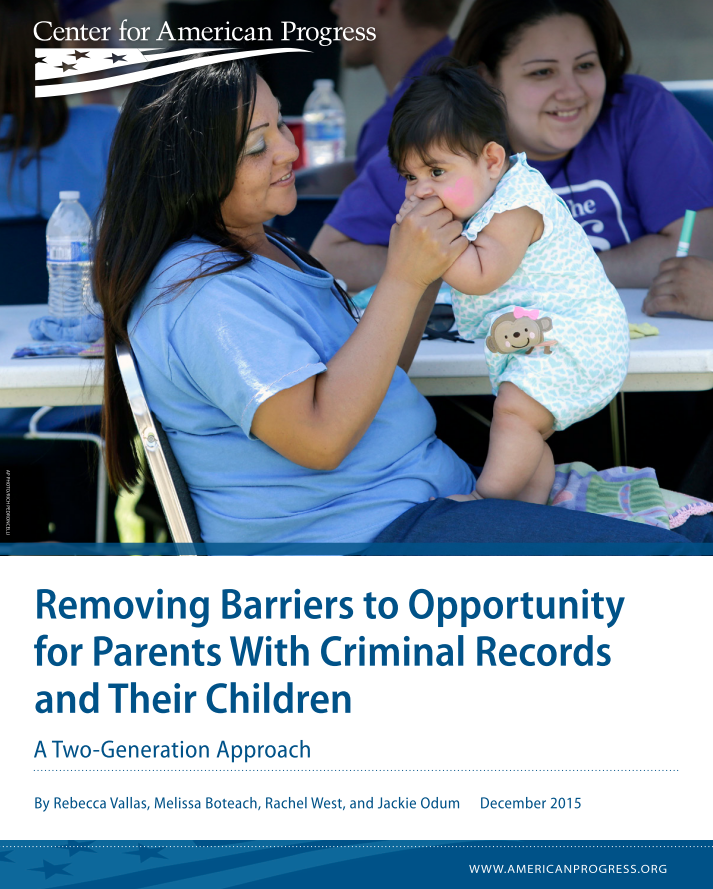
How a parent’s criminal record limits children

“The barriers associated with having a criminal record do not just result in lifelong punishment for the parent with the record; they also can significantly limit a child’s life chances.” This is according to a new report by the Center for American Progress that examines the multi-generational effects of collateral consequences and the cycle of poverty and lost opportunity that those consequences perpetuate. A parent’s criminal record can affect everything from a child’s emotional and physical well-being to future economic and educational outcomes.  This is true even if the record was for a minor conviction that did not result in incarceration or, in some cases, an arrest that did not result in conviction at all. The report specifically examines how a parent’s criminal record can effect “five pillars of family well being:” • Income. Parents with criminal records have lower earning potential, as they often face major obstacles to securing employment and receiving public assistance. • Savings and assets. Mounting criminal justice debts and unaffordable child support arrears severely limit families’ ability to save for the future and can trap them in a cycle of debt. • Education. Parents with criminal records face barriers to education and training opportunities that would increase their chances of finding well-paying jobs and better equip them to support their families. • Housing. Barriers to public as well as private housing for parents with criminal records can lead to housing instability and make family reunification difficult if not impossible. • Family strength and stability. Financial and emotional stressors associated with parental criminal records often pose challenges in maintaining healthy relationships and family stability. In many instances, these effects are the indirect result of collateral consequences that limit a parent’s ability to find a job or pursue education or training; however, there are a number of notable collateral consequences that can have a direct and often severe impact on a child’s well-being. For example, the federal Department of Housing and Urban Development authorizes Public Housing Authorities to exclude or evict entire families from subsidized housing on the basis of a single family member’s “criminal activity,” and, in handful of states, parents with felony drug convictions are permanently barred from receiving federally funded food stamps. The scope of the problem is large both in terms of the number of families currently affected and in terms of the future social consequences. Although the report’s claim that “nearly half of U.S. children now have at least one parent with a criminal record,” may be an overstatement (the methodology used to arrive at that figure relies on a number of questionable assumptions), it is clear that about a third of all Americans have some sort of record. That number represents millions of parents and, in turn, millions of impacted children whose chance of success in adulthood may be diminished. Sadly, we can assume that a disproportionately large number of those children are black or Latino since their parents are more likely to have a criminal record than white parents.  Unless there is significant reform, we can expect to see the racial disparities that the justice system has created among adults of this generation reverberate well into the next. To mitigate these outcomes, the report advocates for a “two generation approach” to reform that “combats intergenerational poverty by boosting education, health, and well-being; economic supports; and social capital for parents and children.” The specific reforms proposed are largely aimed at easing the burdens on parents with criminal records by removing barriers to employment, housing, and education; broadening the availability of sealing and expungement (including automatic expungement of low level offenses after a set period of time); and expanding re-entry services. The report also pushes for the adoption of policies that support family strength and stability in general terms, such as child support reform and the expansion of parent training and support programs like those funded by federal Pathways to Responsible Fatherhood Demonstration grants. You can find the full report, Removing Barriers to Opportunity for Parents With Criminal Records and Their Children: A Two-Generation Approach, at this link. Read more

“One Strike and You’re Out:” Center for American Progress reports on criminal records policy

Earlier this week, the Center for American Progress published a new report on the effect of the proliferation of criminal records in a nation of mass incarceration and criminalization. The report (“One Strike and You’re Out: How We Can Eliminate Barriers to Economic Security and Mobility for People with Criminal Records”) explores the debilitating effect that a criminal record – including records for relatively minor offenses and for arrests that did not result in a conviction – can have on an individual’s access to housing, public assistance, education, family stability, and, in turn, their prospects for economic stability. The report’s authors are Rebecca Vallas of the Center for American Progress’s Poverty and Prosperity Program, and Sharon Dietrich of Community Legal Services of Philadelphia (and of our own CCRC Board). The report makes the point that the proliferation of criminal records, and the ease with which they can be accessed, harms not only individuals but society as a whole. The collateral consequences of a criminal record result in employment losses of $65 billion a year in GDP according to one study cited. Another study estimates that the national poverty rate would have dropped by 20 percent between 1980 and 2004 if not for mass incarceration and the accompanying criminal record crisis. The report notes that the war on drugs and the “criminalization of poverty” has resulted in a disproportionately high incidence of justice system contact in communities of color. Criminal records are thus both a cause of poverty and a consequence of poverty. “Failure to address the barriers associated with having a record as part of a larger antipoverty strategy risks missing a huge piece of the puzzle,” Vallas told me shortly after the report’s publication. “On the flip side, enacting policies to remove those barriers and provide a second chance has the potential to make a huge dent in our nation’s poverty rate.” To this end, the report recommends broadening access to expungement and record sealing, expanding fair employment and housing protections, and requiring accuracy in criminal background checks. Some of the recommendations target specific collateral consequences like the felony drug ban for federal nutrition assistance, and for federal financial aid for those with drug convictions. The report also gives examples of laws and policies already on the books that can serve as models for reform. I also asked Vallas about the prospects for meaningful reform in the current political climate. This is what she had to say: Bipartisan momentum in support of criminal justice reform — including second-chance policies — has been growing for the past several years. We seem to have moved past the “tough-on-crime” era and into a new “smart-on-crime” era with increased support for criminal justice policies that avoid needless incarceration. This shift appears to have happened in part because of the enormous costs of incarceration — the U.S. spends more than $80 billion per year on locking people up, and more than $270 billion per year if you count the costs of law enforcement, policing, etc. — and because of increased interest in evidence-based policies that support reentry, reduce recidivism, and increase public safety and spend law enforcement resources more effectively. There’s also a strong faith-based argument, that we’re a society that practices and values redemption. Additionally, the impact on the national economy has begun to get people’s attention. A study by the Center for Economic and Policy Research, or CEPR, which we cite in the report, finds that the cost of employment losses from people with records being shut out of the labor market is as high as $65 billion per year in GDP terms. That’s a big hit to our nation’s bottom line. In researching the report, I pulled together a bunch of quotes from prominent elected officials and thought leaders across the political spectrum, calling for criminal justice reform and second-chance policies—and I realized that when you take away the names of who said them, it’s nearly impossible to tell whether each came from a Democrat or a Republican. It’s extremely encouraging, especially at a time when the word “bipartisan” doesn’t apply to too many issues. There’s a lot of hope and optimism that we’ll see real progress on these issues in the next Congress, as well as continued positive steps at the state and local levels. Editor’s note: We think it is particularly hopeful that the Center for American Progress, generally considered the think tank of the Democratic Party, is now taking an interest in issues that for many years have been considered a third rail by progressive candidates for office. Perhaps a constructive practical approach to criminal justice issues will replace fear-mongering and stereotypes in the 2016 election cycle. Perhaps we can finally abandon the unfortunate phrase “soft on crime” without needing to be reassured that we are being smart about it.  —  Read more