“The Mark of Policing: Race and Criminal Records”

This is the title of an important symposium piece by Eisha Jain published by the Stanford Law Review, in which she urges that “racial reckoning in policing” include consideration of the negative credentialing effect of arrest records. Using the sociological framework of “marking,” Jain shows how unjustified arrests “both magnify and conceal race-based discrimination.” She argues that “Reckoning with race in the criminal justice system requires recognizing that the problem is not just the police: It is with a legal regime that entrenches racial subordination through criminal records.”

The good news is that many of the criminal record reforms of the last several years provide for automatic or expedited expungement or sealing of non-conviction records. (See our 50-state chart on “Process for expunging or sealing non-convictions” and our Model Law on Non-Conviction Records recommending automatic expungement.) But the bad news is that even the laws streamlining the sealing of non-conviction records in two dozen states frequently fail to extend to records of uncharged arrests, which can linger in police files and repositories long after court records have been sealed. In the hands of police agencies, they may lead to further policing abuses. Disseminated through background checks and the internet they limit employment, housing, and other opportunities. When considering how to neutralize the effect of non-conviction records, jurisdictions must concern themselves with this neglected source of racial inequity.

Here is the abstract of Professor Jain’s article:

This Essay argues that racial reckoning in policing should include a racial reckoning in the use of criminal records. Arrests alone—regardless of whether they result in convictions—create criminal records. Yet because the literature on criminal records most often focuses on prisoner reentry and on the consequences of criminal conviction, it is easy to overlook the connections between policing decisions and collateral consequences. This Essay employs the sociological framework of marking to show how criminal records entrench racial inequality stemming from policing. The marking framework recognizes that the government creates a negative credential every time it creates a record of arrest as well as conviction. Such records, in turn, trigger cascading consequences for employment, housing, immigration, and a host of other areas. The credentialing process matters because it enables and conceals race-based discrimination, and because a focus on the formal sentence often renders this discrimination invisible. This Essay considers how adopting a credentialing framework offers a way to surface, and ultimately to address, how race-based policing leaves lasting marks on over-policed communities.

See the full essay here.
New occupational licensing laws in 2021

In the first five months of 2021, seven states and the District of Columbia enacted nine separate laws improving opportunities for people with a criminal record to obtain occupational licenses. This continues a four-year trend begun in 2017 that has seen 33 states and the District of Columbia enact 54 separate laws regulating consideration of criminal record in the licensing process.

Our report on new legislation in 2020 noted that “[o]f all the criminal record reforms enacted during this modern reintegration reform era, no other approaches the regulation of occupational licensing agencies in terms of breadth, consistency, and likely efficacy.” Laws enacted during this four-year period have “transformed the licensing policy landscape across the Nation and opened opportunities in regulated professions for many thousands of people.” The only period of law reform that rivals the present one came during the early 1970s, when many of the laws now being revised and extended were first enacted. The effectiveness of advocacy efforts by the Institute for Justice and National Employment Law Project in influencing this trend cannot be overstated.

So far during 2021, the U.S. jurisdiction to have enacted the most ambitious and comprehensive licensing scheme is the District of Columbia, and its new law (described in detail below) is one of the most progressive in the nation. New Jersey, New Mexico and Washington had not previously legislated in this area for many years, and all three extended and improved laws first enacted in the 1970s. Arizona, Georgia, Ohio, and Tennessee extended recently enacted laws, with Arizona legislating for the fourth time in this area in as many years!

The nine new laws are described below, and have been added to the state profiles and 50-state charts of the Restoration of Rights Project.

Read more

“Tribal Pardons: A Comparative Study”

This is the title of a fascinating new working paper by Andrew Novak, Assistant Professor of Criminology, Law and Society at George Mason University, about a little-studied issue: collateral consequences of tribal convictions and how they are mitigated or avoided.  This is an important topic not currently addressed in our national resources on restoration of rights and record relief.  Here is the abstract:

This paper surveys American Indian tribal justice systems to assess whether collateral consequences attach to convictions and whether a pardon or expungement process exists to remove tribal convictions. Tribal criminal jurisdiction is often limited to lesser crimes and only those occurring on a reservation by members of the tribe; with exceptions, other cases are transferred to U.S. state or federal court. The framework of the tribal pardon power varies widely across jurisdictions: it may be exercised by a tribal executive, a tribal legislature or council, a specially appointed pardons board or committee, a vote of the tribal membership, or some combination of the above. Some jurisdictions instead have a traditional peacemaking, forgiveness, or reconciliation ritual process in lieu of a true pardon or expungement process.

Many Indian tribes impose collateral consequences for convictions both in tribal court and in state or federal court. Most commonly, these consequences restrict tribal membership and rights, including the right to vote in tribal elections or hold tribal office, but they may extend to housing, gaming licenses, tribal employment, and other areas. Many tribal jurisdictions do not have a pardon or expungement process, despite having collateral consequences attach to convictions. Several tribal courts have considered whether their tribal constitutions create an implied pardon power where one is not specifically provided for in tribal law. As a normative matter, this paper takes the position that tribal jurisdictions should have a pardon or expungement process (or its equivalent in indigenous law) where collateral consequences attach to conviction.

The draft of this working paper is available here.

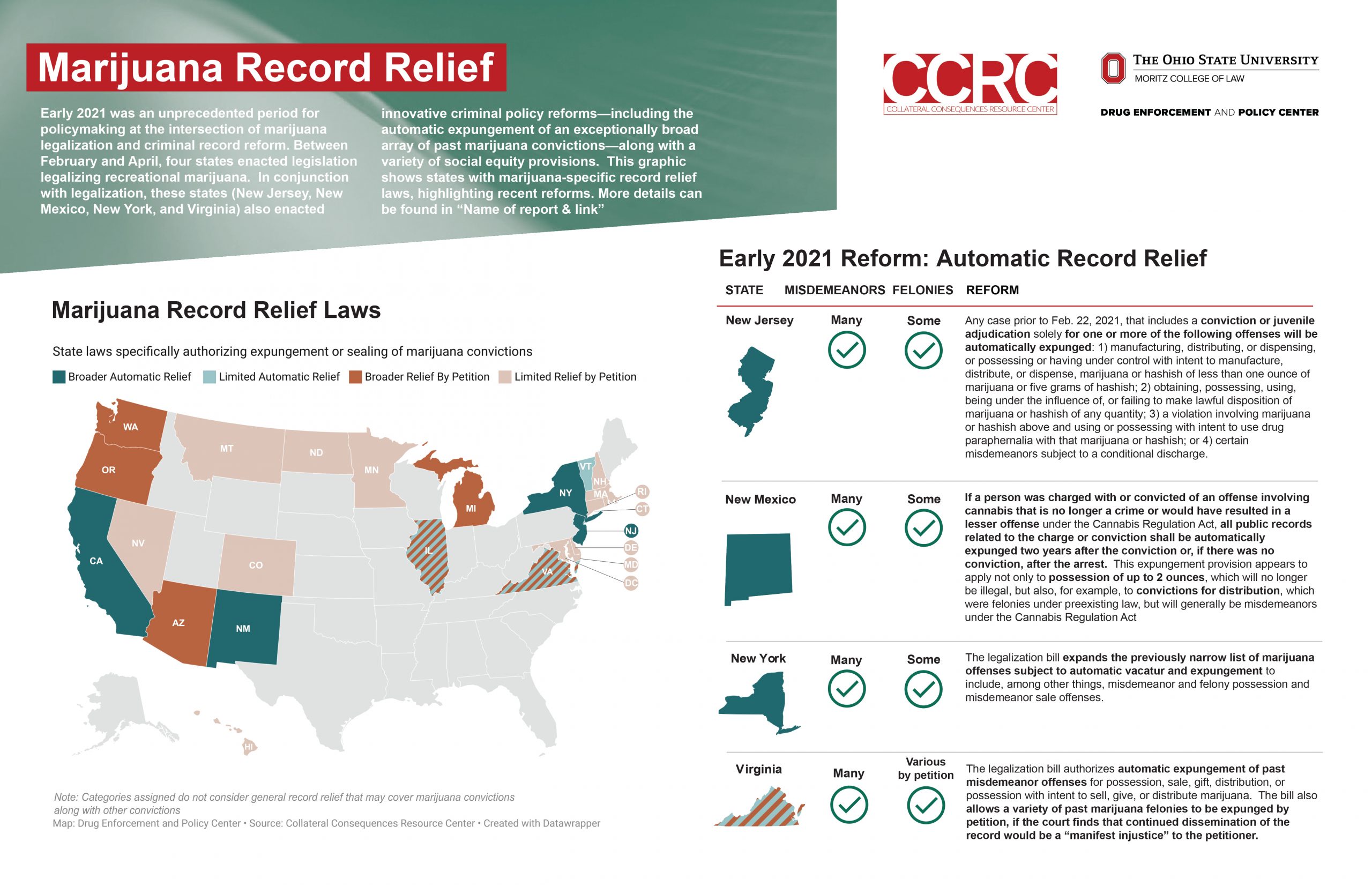
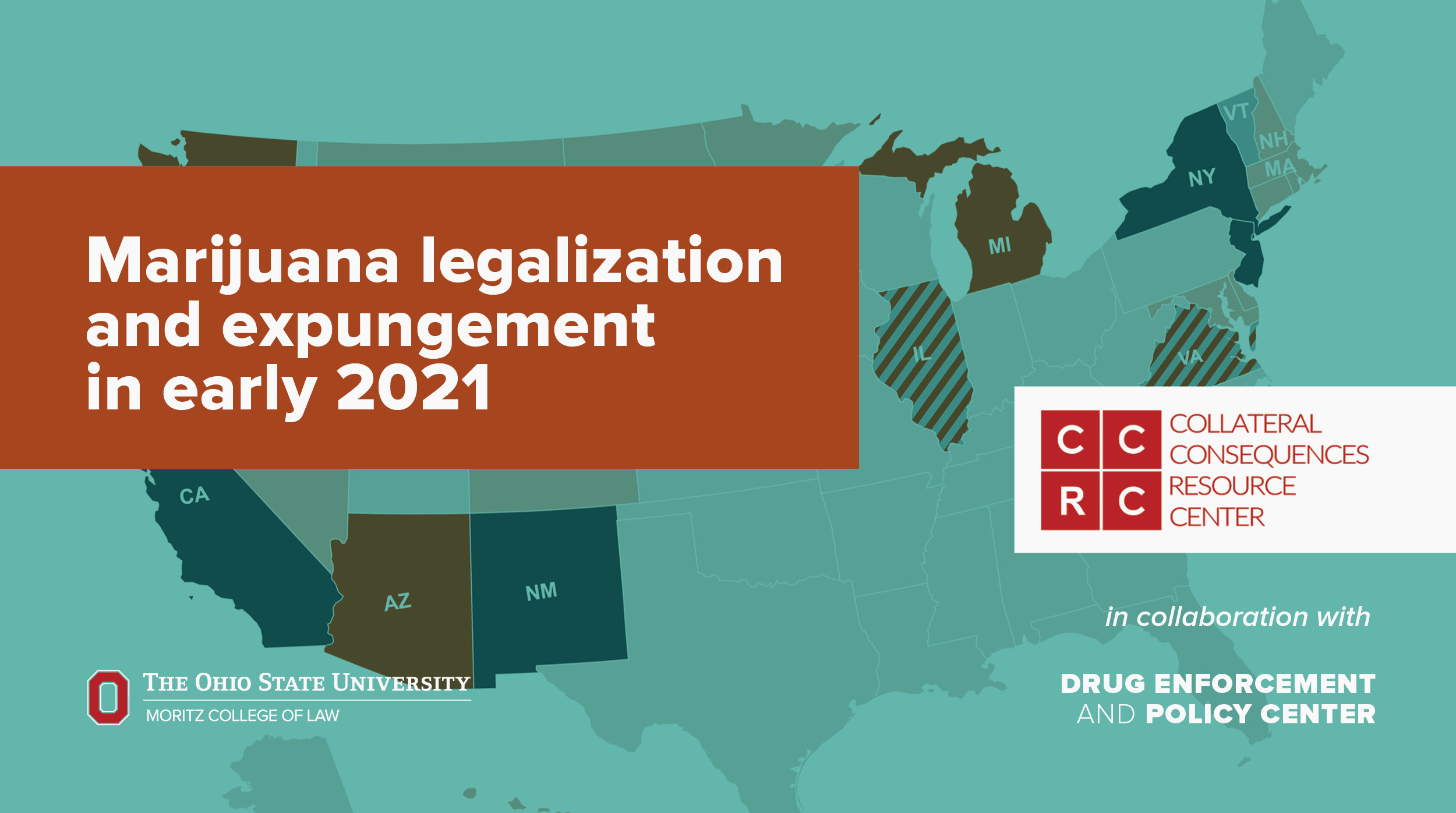
Marijuana legalization and expungement in early 2021

The Collateral Consequences Resource Center, with support from the Drug Enforcement and Policy Center, produced a report and an accompanying infographic that summarize the groundbreaking criminal reforms enacted this year as part of marijuana legalization and situate them in the national context.

Read more

People with records excluded from growing occupations

People with arrest and conviction records continue to demand that employers and policymakers remove unfair barriers to work. Their demands have spurred much-needed legislative change, including “fair chance licensing” laws that reform restrictions on working in occupations requiring a government license or certification. Such changes are crucial to achieving racial equity. Decades of biased policing and charging have left Black and Latinx communities with disproportionately high rates of records, thus compounding the economic disinvestment and other disadvantages resulting from structural racism.

In support of fair chance licensing advocacy efforts, the National Employment Law Project (NELP) recently developed a set of short fact sheets evaluating the legal barriers that face people with records who desire to work in growing occupations in eight states–Colorado, Delaware, Indiana, Louisiana, Michigan, Ohio, Oregon, and Tennessee. Given the confusing tangle of statutory and regulatory restrictions in most states, focusing on growing professions in high-demand industries may prove to be an important strategy for state advocates who seek to maximize job opportunities for people with records.

Read more