The High Cost of a Fresh Start: New Report Examines Court Debt as a Barrier to Clearing a Conviction Record BOSTON – A new report from the National Consumer Law Center and the Collateral Consequences Resource Center explores the extent to which court debt—such as criminal fines, fees, costs, and restitution—is a barrier to record clearing that prevents poor and low-income people from getting a second chance. For the nearly one-third of adults in the U.S. with a record of arrest or conviction, their record is not simply part of their past but a continuing condition that impacts nearly every aspect of their life. Their record makes it hard to get a job and support a family, secure a place to live, contribute to the community, and participate fully in civic affairs. “Criminal record clearing must not be reserved only for those who can easily pay for it,” said Margaret Love, executive director of CCRC. “States should ensure people are not being priced out of a chance at a fresh start.” The High Cost of a Fresh Start: A State-by-State Analysis of Court Debt as a Bar to Record Clearing analyzes whether outstanding court debt bars record clearing under the laws of each of the 50 […]
Read moreCategory: Fines and fees
CFPB documents the financial burdens imposed on justice-involved individuals
The Consumer Financial Protection Bureau has just issued an extraordinary new report on the financial challenges faced by justice-involved individuals in navigating each stage of the criminal justice system. The report, which describes itself as “the first of its kind done by the CFPB,” paints a devastating picture of how the criminal law enforcement system conspires at every step to exacerbate the financially precarious situation in which many entering the justice system already find themselves. “Justice-Involved Individuals and the Consumer Financial Marketplace” documents in clear and compelling prose how the financial products and services marketed to individuals and families entangled in the criminal justice system “too often contain exploitative terms and features, offer little or no consumer choice, and can have long-term negative consequences for the individuals and families affected.” What the CFPB researchers found “raises serious questions about the transparency, fairness, and availability of consumer choice in markets associated with the justice system, as well as demonstrating the pervasive reach of predatory practices targeted at justice-involved individuals.”
Read moreFederal policies block loans to small business owners with a record
Starting a small business is increasingly recognized as a pathway to opportunity for individuals with an arrest or conviction history—particularly given the disadvantages they face in the labor market. An estimated 4% of small businesses in the United States have an owner with a conviction (1.5% have a felony conviction). Small businesses provide “a vital opportunity for those with a criminal record to contribute to society, to earn an honest profit, and to give back to others.” They also frequently employ people with a record and help reduce recidivism. A growing number of organizations and government programs are devoted to supporting individuals with a record in building their own businesses. Yet many structural barriers remain, including a series of little-known federal regulations and policies that impose broad criminal history restrictions on access to government-sponsored business loans, notably by the U.S. Small Business Administration (SBA). A recent article illustrates the steep challenges faced by business owners with a record by telling the stories of several entrepreneurs who were either denied an SBA loan or were discouraged from even trying for one because of a dated felony conviction. One of those entrepreneurs comments: “You might do five years, ten years, one year, […]
Read moreNew Mexico a new leader in criminal record reforms
This year, New Mexico enacted three significant laws restoring rights and opportunities to people with a criminal record, continuing a recent trend of major reforms in this area. The three measures involve adopting most of the provisions of the Uniform Collateral Consequences of Conviction Act, authorizing automatic expungement for a broad range of marijuana offenses as part of legalization, and expanding existing law regulating public employment and licensure to prohibit consideration of many types of convictions. A fourth new law significantly limits burdens imposed by court debt. These developments follow 2019 reforms introducing expungement into the state’s legal system for the very first time—through a comprehensive system of petition-based relief for most types of criminal records—and adopting a private sector ban-the-box law. For these 2019 reforms, New Mexico earned an “honorable mention” for a productive legislative season in our reintegration report card for that year. This year’s noteworthy follow-up measures, summarized below, make New Mexico a contender for CCRC’s “reintegration champion” award in 2021.
Read moreSecond Chance Month: A Federal Reintegration Agenda
In 2017, Prison Fellowship declared April Second Chance Month for the first time. The designation has since gained support from Congress, the White House, state and local bodies, and nongovernmental organizations, as an opportunity to raise awareness about the collateral consequences of arrest or conviction along with the importance of providing second-chance opportunities for people with a record to reintegrate into society. CCRC’s flagship resource, the Restoration of Rights Project provides 50-state resources detailing current law and practice for four types of second-chance remedies: (1) restoration of civil and firearms rights; (2) pardoning; (3) expungement, sealing, and other record relief; and (4) limits on consideration of criminal records in employment and occupational licensing. Our annual reports on new legislation document the astonishing pace of state reform action on these issue since 2013. We are proud to see these resources utilized by impacted individuals, attorneys, advocates, journalists, scholars, lawmakers, courts, and others to understand second-chance remedies, pursue relief, and bring about reforms. President Biden’s Proclamation on Second Chance Month declares that the criminal justice system must offer “meaningful opportunities for redemption and rehabilitation”: Every person leaving incarceration should have housing, the opportunity at a decent job, and health care. A person’s […]
Read moreRestoration of Firearm Rights After Conviction: A National Survey and Recommendations for Reform (Dec. 2025)
Positive Credentials That Limit Risk: A Report on Certificates of Relief (June 2024)
Advancing Second Chances: Clean Slate and Other Record Reforms in 2023 (Jan. 2024)
Accessing SNAP and TANF Benefits after a Drug Conviction: A Survey of State Laws (Dec. 2023)
The Many Roads from Reentry to Reintegration (March 2022)
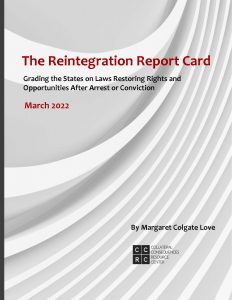
The Reintegration Report Card